

How Global Mangrove Watch Empowers Local Action in Indonesia
-
Global Mangrove Watch
By Niharika Iyengar
When you think of mangrove conservation, you might picture muddy roots, winding rivers, and field boots — not satellite dashboards. But for the Indonesia chapter of the Global Mangrove Alliance (GMA), the work to protect these ecosystems starts with pixels and data layers.
Together, the organizations involved contribute to scaling mangrove conservation and restoration in Indonesia, the opportunities for which are summarized in the Mobilizing the Mangrove Breakthrough in Indonesia report .
Indonesia hosts the largest and most diverse mangrove ecosystem. Spanning 2.95 million hectares, they constitute more than 20% of the world’s remaining mangroves. While some areas are still relatively intact, mangroves in densely populated regions such as Java and Bali have been severely degraded.
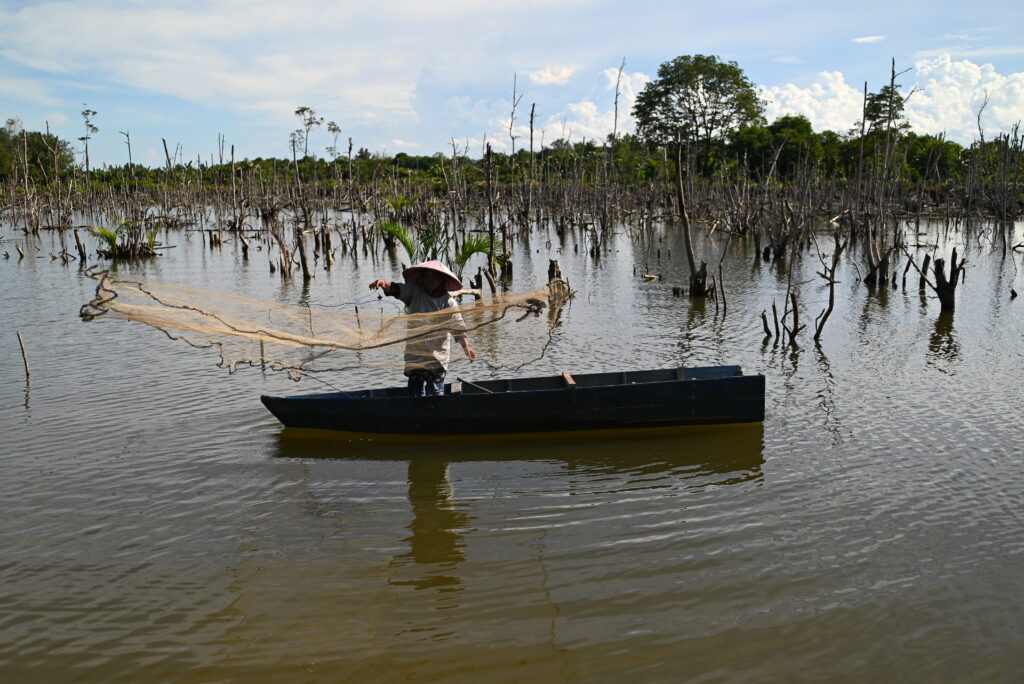
For a nation of islands, mangroves provide essential services, including coastal protection, carbon sequestration, livelihoods, and support for fisheries and other coastal and marine life, all of which directly contribute to social, economic, and environmental well-being.
These ecosystems have historically supported key industries such as fisheries, aquaculture, and tourism. However, more than half of Indonesia’s mangrove forests are already degraded. Conversion of mangrove areas for agriculture and aquaculture, forestry plantations, industrial activities, and urban expansion has come at a considerable ecological cost. Widespread mangrove deforestation and degradation have severely undermined these ecosystems’ ability to provide services, threatening not only their ecological integrity but also the substantial economic and social benefits they offer.
60% of Indonesia’s population lives in coastal areas and it is estimated that mangroves contribute USD 1.5billion annually to the Indonesian economy from fisheries alone, making it critical to conserve and restore these habitats. Fortunately, mangrove rehabilitation is a national priority, and organizations working cooperatively – like the Global Mangrove Alliance – are making significant progress.
But effective mangrove protection requires accurate and up-to-date spatial data to prioritize actions and monitor progress. This is where Global Mangrove Watch (GMW) comes in, an online platform that provides the remote sensing data and tools for monitoring mangroves necessary for this. It gives universal access to near real-time information on where and what changes there are to mangroves across the world.
For Topik Hidayat, a Blue Carbon Analyst at The Nature Conservancy (TNC) Indonesia: Yayasan Konservasi Alam Nusantara, Global Mangrove Watch has transformed how his team identifies both threats and opportunities.
“We analyze mangrove restoration potential and deforestation trends year by year,” he explains. “One of the platform’s tools used extensively for patrols by communities is the Mangrove Loss Alerts. It detects in real time areas that are experiencing significant mangrove losses, and we can verify these alerts on the ground.”
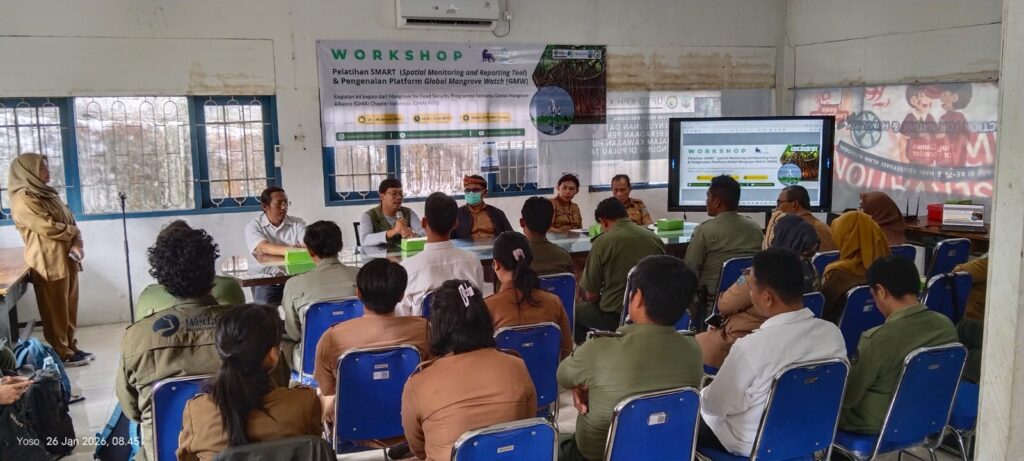
Topik’s team has trained local communities in several sites to interpret and act on these alerts, including in Bengkalis (Riau Province), Ogan Komering Ilir (South Sumatra Province), Berau (East Kalimantan Province) and Bangka (Belitung Province).
The same data powers national-scale work too. “We also use the blue carbon feature of Global Mangrove Watch for feasibility studies,” Topik adds. “A combination of the various layers in the tool helps us assess which sites have the potential for carbon projects throughout Indonesia.”
Aji Nuralam, Technical Officer Rehabilitation at Wetlands International Indonesia, adds: “Right now, we use Global Mangrove Watch mainly for preliminary assessments — to identify where rehabilitation and protection should happen. Then we verify the data using local measurements and community input.”
Several Global Mangrove Alliance Indonesia members remember what monitoring used to look like before Global Mangrove Watch.
Muhammad Miftahul Bayyan, a Remote Sensing Specialist at TNC Indonesia, recalls the painstaking process: “We used to download satellite data manually from Google Earth Engine and other sources, year by year, and analyze it ourselves. It took a lot of time to draw comparisons to past data. But with Global Mangrove Watch, we can easily see deforestation rates from 1990 to today. It’s so much faster to use this with national data sets to analyze mangrove cover.”
Arsen Makomi, a GIS and Data Analyst at Konservasi Indonesia (Conservation International), adds that Global Mangrove Watch made carbon analysis in particular more consistent: “Before, we had to compile mangrove biomass and soil carbon data from different sources. Now, we can use globally consistent datasets. It’s really helpful for monitoring and preliminary studies.”
As much as Global Mangrove Watch has empowered their work, Indonesia’s mangrove practitioners have ideas for making it even more effective.
Topik hopes for a mobile and offline version that communities can use in the field.
“We often combine Global Mangrove Watch with Global Forest Watch, which can be used offline and on a mobile app,” he explains. “If Global Mangrove Watch had that too, it would be very powerful.”
Additionally, he and Aji use the Mangrove Restoration Tracker Tool but wish for an improvement in terminology used and for MRTT to regularly track monitoring data. “Right now, the restoration potential layer is quite large-scale,” says Aji. “If we could refine it for site-level use, it would help us plan projects more precisely.” This is important because the Indonesian government is very keen to know which areas have restoration potential.
Arsen adds one final wish: “It would be great if more of the data could be downloaded for deeper GIS analysis.”
Even as the teams juggle field realities, their shared enthusiasm for Global Mangrove Watch is unmistakable. Together, they’ve learned to blend global datasets with local knowledge — something that’s becoming a hallmark of Indonesia’s approach to mangrove conservation and restoration. Global Mangrove Watch is a model for how data-driven tools can power real-world conservation.