

Reviving Mangroves in Abandoned Rice Fields: A Case Study from Guinea-Bissau
Amid the intricate coastal landscape of Guinea-Bissau, mangroves are more than just trees—they are vital lifelines. These ecosystems offer shelter, sustenance, and economic opportunities to local communities, while also serving as nature’s frontline defence against climate change. Yet, this fragile balance has been disrupted over time, resulting in the abandonment of rice fields and the steady decline of mangrove cover. The State of the World’s Mangroves 2024 report reveals that converting mangroves for rice cultivation accounts for 8.4% of global mangrove loss. In Guinea-Bissau, this practice has left a significant mark, with vast areas of mangrove forests sacrificed to meet the demand for rice. Today, a new wave of restoration efforts, led by organisations like Wetlands International, is working to reverse the damage and breathe life back into these neglected fields.
The rise and fall of rice fields
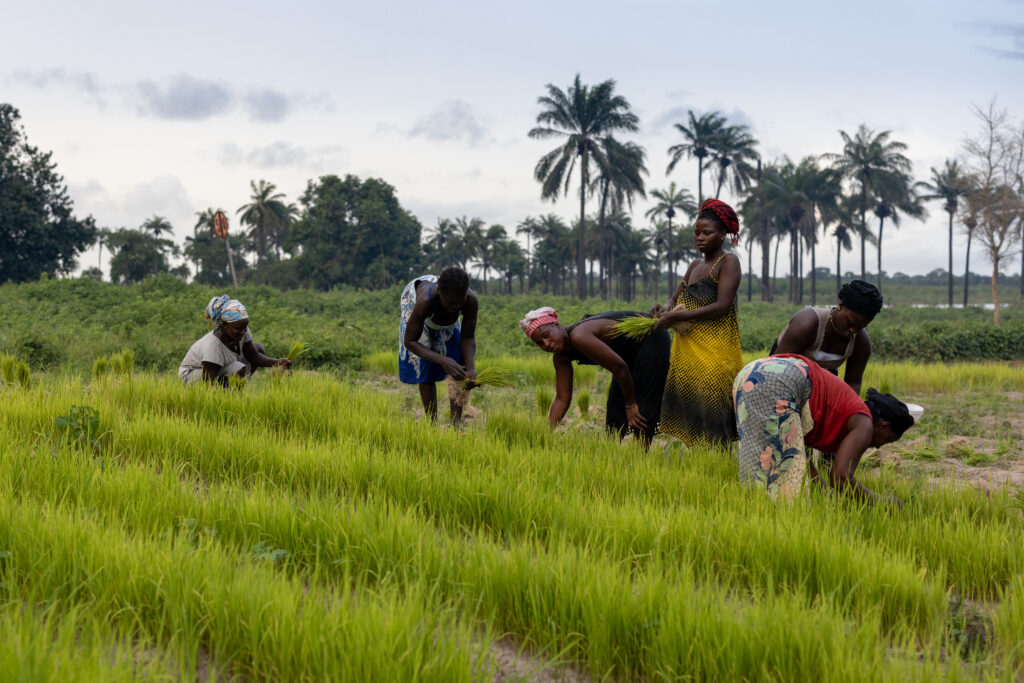
Historically, mangroves were cleared to create rice fields – known locally as bolanhas. Rice cultivation, a primary food source and economic activity, required extensive work from local communities who specialised in building dykes and draining saltwater from mangrove forests. Ethnic groups like the Felupe and Balanta invested tremendous efforts to sustain these polders, hand-carving them out of the mangrove terrain.
However, as the dynamics of the economy and environment changed, rice cultivation became less attractive. The rise of cashew nut production – a more profitable cash crop – drew farmers away from rice fields. Simultaneously, Guinea-Bissau saw a rural exodus of young people to urban centres, leaving fewer hands to maintain these labour-intensive fields. Climate change further exacerbated the situation. Rising sea levels and changing rainfall patterns led to saltwater intrusion, making the soil too saline for rice cultivation. Abdoulaye Ndiaye (Laye), Programme Manager in Guinea-Bissau, explains, “With the sea level rising, the sea will increasingly overtop the dykes, destroying crops unless there’s a sufficient barrier of mangroves at the water’s edge.”
The consequence of abandonment
As rice fields were abandoned, their infrastructure became a problem. The dykes, which once held back saltwater, now blocked natural tidal flows that were crucial for mangrove regeneration. Without these flows, the soil salinated further, and mangrove seedlings could not take root. This stagnation trapped communities in a cycle where neither rice nor mangroves could thrive. Without these vital ecosystems, local populations faced a lack of food and business opportunities, leading to even more migration to cities.
Opening the gates
In response to these challenges, Wetlands International, which has been active in Guinea-Bissau for over 24 years, launched its first Ecological Mangrove Restoration (EMR) project in 2015. This transformative approach focuses on understanding the initial conditions of each site to assess whether mangrove restoration is feasible and what it will entail. To date, Wetlands International has restored over 2,600 hectares of abandoned rice fields, engaging more than 3,000 community members, National Park staff, and local NGOs in these efforts.
The restoration process in the former rice fields begins by reopening the dykes, allowing water to flood back into the fields. This reintroduction of water carries seedlings, sediments, and nutrients, creating conditions essential for mangrove growth. A simple field protocol for monitoring and evaluation plays a critical role here by tracking changes in water flow, soil salinity, and biodiversity. This data helps adjust strategies as needed, ensuring that the restoration efforts are sustainable and effective over the long term. “To restore mangroves, we open up dykes and clean the old natural canals to allow the water to renew with each tidal cycle and to allow seedlings to enter the site and slowly regrow,” Laye states. It can take between five to ten years, depending on site-specific-factors, for mangroves in abandoned ricefields to fully restore, during which time they require monitoring and maintenance.
When the mangrove seedlings start to grow, the impact is transformative. The water’s natural flow brings back a host of plant and animal species, including crabs, birds, and fish, re-establishing the intricate web of life that sustains local communities.
Community involvement: a pillar of restoration
Reviving these ecosystems goes beyond mere ecological work; it’s a cultural and community-driven effort. Wetlands International has played a pivotal role in mobilising local communities, providing them with training and resources to lead the restoration activities. Men in the villages dig canals to break the dykes, while women support the restoration logistics by cooking and taking care of children.
Women also play a crucial role through investing in Savings and Loans groups that support mangrove-friendly economic activities, reducing the negative impact on mangroves, and creating a cycle of sustainable livelihoods.
Since 2015, Wetlands International has established 45 Savings and Loans groups with over 1,000 members in Guinea Bissau, providing loans primarily for palm oil production, fish selling, soap processing, beekeeping and peanut cultivation. These groups have improved the livelihoods of over 6,000 community members, demonstrating how sustainable development and mangrove conservation can go hand in hand.

Additionally, Wetlands International supports economic activities like vegetable gardens, benefiting 530 women, and rehabilitating belt dykes to prevent saltwater intrusion, positively impacting 667 households which represent over 4,000 community members. These initiatives reduce the need to clear mangrove areas for new cultivation, preserving sensitive ecosystems.
Local beekeeper Daniel shares his story, highlighting how community education, supported by Wetlands International, has transformed perspectives. “We used to cut down mangroves because we didn’t know their value. But now, we’ve learned their importance and we’ve stopped cutting.” His initiative to produce mangrove honey showcases how alternative income sources are being developed through these projects.
Balancing conservation and development
Jean-Louis Sanka, Representative at the International Union for the Conservation of Nature (IUCN) in Guinea-Bissau, emphasises the importance of finding a balance between economic development and conservation: “It is increasingly imperative to move towards conservation-development-value chain nexuses; there will be less pressure on resources if we provide economical solutions.” The mangrove restoration projects of Wetlands International in Guinea-Bissau, embody this approach by integrating ecological mangrove restoration with improved rice field management, ensuring that active fields can coexist alongside mangroves as natural salt buffers, while also preventing the expansion of rice cultivation into other mangrove areas.
In some cases, villagers are encouraged to flatten the dykes on the margins of abandoned rice fields to let the sea and seedlings in, naturally restoring the mangroves. In return, they receive support to reinforce the dykes around the most essential rice fields, creating a balance where both natural ecosystems and rice paddies can thrive. “The communities are at the heart of the restoration,” asserts Laye.
Beyond restoring mangroves, Wetlands International has also improved the conservation status of 82,000 hectares of mangroves by supporting two protected areas – Cacheu Natural Park and Cantanhez National Park. Thanks to the efforts carried out by park rangers – by enhancing monitoring and surveillance – harmful activities such as illegal fishing and mangrove harvesting have been reduced, contributing to the overall stability of these ecosystems.

The broader impact and future vision
The restoration of mangroves not only brings back ecological balance but also revitalises local economies and culture. For every mangrove restored, fish populations increase, providing food and income. “If there are healthy mangroves, there are fish; if there are fish, there is food and business,” explains Laye. The hope is that through these efforts, communities will thrive once more, reversing the exodus to urban areas.
Looking forward, the success of the mangrove restoration projects in Guinea-Bissau could serve as a model for other coastal regions facing similar challenges. With around 2,600 hectares already restored and additional plans underway, the impact is substantial. Wetlands International has also supported environmental education in 10 schools, training 50 teachers and raising awareness among 500 students about the importance of mangrove conservation. The creation of six environmental clubs ensures long-term sustainability by empowering the next generation of conservationists.
Cacheu Natural Park, a Ramsar site of international importance, contains the largest area of mangrove forest in West Africa, where thousands of migratory birds come to winter each year. The broader vision is to create sustainable ecosystems that not only serve local communities but also contribute to global biodiversity conservation efforts.
With Wetlands International and local communities working hand in hand through the EMR programme, Guinea-Bissau is forging a path that intertwines conservation with community well-being, proving that when people and nature work together, both can thrive.