
The Wetland Atlas Launch
Solutions and knowledge on how to restore degraded wetlands already exist. But a massive gap remains in financing wetland action. To meet global biodiversity, climate and land restoration targets, investments in nature-based solutions, such as wetland conservation and restoration, must increase to USD 571 billion annually by 2030—equivalent to just 0.5 per cent of global GDP.
One of the barriers to wetland finance can be a lack of relevant data.
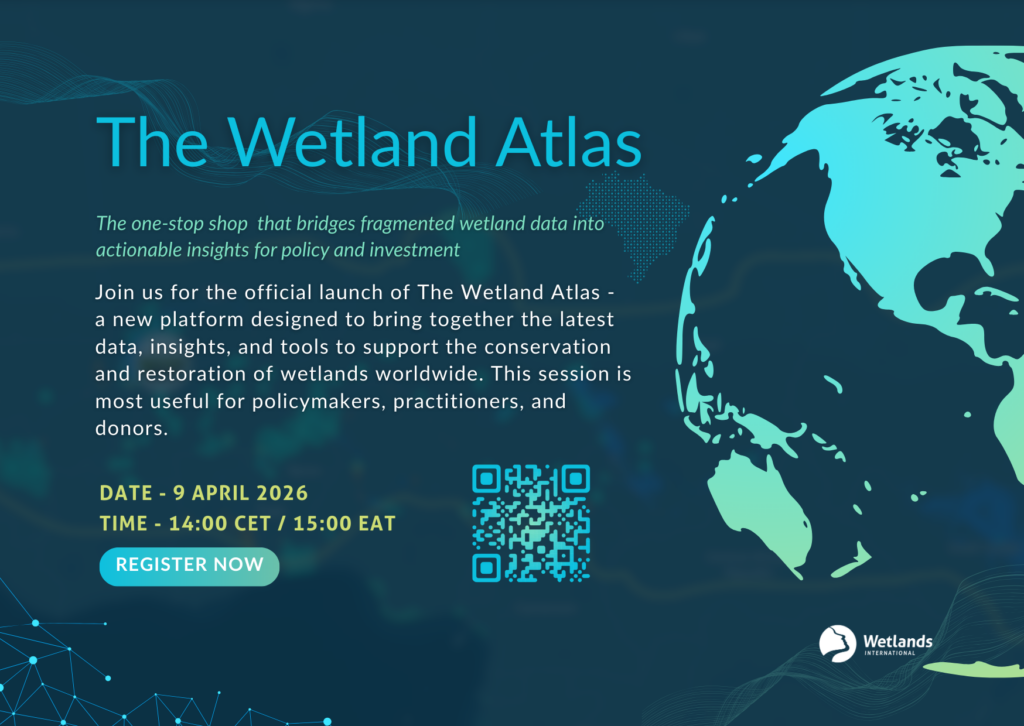
To help address this gap, Wetlands International is excited to launch The Wetland Atlas – an online tool to map the world’s wetlands. The Wetland Atlas brings scattered data together into one easy-to-use platform, not only showing where and what type of wetlands exist but also their climate mitigation potential, the proportion of people dependent on their surrounding wetlands, and if they are currently protected. By filling in these information gaps, The Wetland Atlas makes it easy to direct investments and policy interventions into wetland protection and restoration for maximum benefit. During the launch, we will share our wider vision for this platform, introduce the prototype for the Sahel region and its core functionalities, demonstrate how it can support decision-making and investment prioritisation.
The Wetland Atlas builds on Wetlands International’s long-standing role in global wetland science, policy engagement, and mapping initiatives such as the Global Mangrove Watch, the Critical Sites Network Tool, the Waterbird Populations Portal and the International Waterbird Census.
Join us for the official launch of The Wetland Atlas by registering below. This session is most useful for policymakers, practitioners, and donors. During the launch, we will share our wider vision for this platform, introduce the prototype for the Sahel region and its core functionalities, demonstrate how it can support decision-making and investment prioritisation
Why wetlands?
Wetlands are among the most productive yet threatened ecosystems on Earth. Wetlands are climate superheroes: coastal wetlands like mangroves and seagrass meadows store large amounts of carbon and protect shorelines from sea level rise; peatlands are rich carbon stores that also regulate floods and droughts. Wetlands are biodiversity havens, supporting a large variety of flora and fauna including several endangered species. Healthy wetlands underpin our societies and economies. They provide more than one billion livelihoods across the world – through aquaculture, crop production, transport, and tourism. Fish harvested from wetlands provide the primary source of protein for more than one billion people and rice paddies feed 3.5 billion people annually. The estimated annual economic value of water and freshwater ecosystems is USD58 trillion – equivalent to 60% of global GDP. And urban wetlands provide spaces for citizens to connect with nature and improve their mental and physical health.
Despite their importance, we have lost 22% of the world’s wetlands since 1970, and we continue to lose them at alarming rates. The biggest threat to wetlands comes from humans. We have lost vital wetland connectivity through dams, dykes, drains, ditches, and deforestation. The loss and degradation of wetlands has a chain reaction, driving biodiversity loss, stressing food and water supplies, and exacerbating the impacts of climate change like floods, droughts and wildfires.