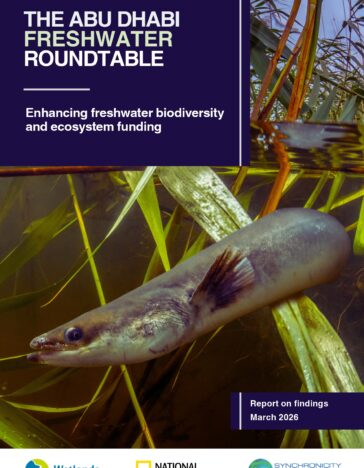

The Abu Dhabi Freshwater Roundtable Report
Freshwater ecosystems, rivers, lakes, wetlands, and floodplains, are among the most
biodiverse and most threatened ecosystems on Earth – supporting at least 10% of all know species. They are also central to water and food security, climate resilience and economic prosperity.
But despite their extraordinary ecological, social, and economic importance, conservation of freshwater ecosystems remains severely underfunded.
To address this gap, funders and practitioners convened a roundtable at the IUCN World Conservation Congress in Abu Dhabi, co-hosted by the National Geographic Society, Synchronicity Earth and Wetlands International. The participants explored barriers to funding freshwater conservation, and identified ways to overcome them. This report synthesises those insights.
Four systemic obstacles to freshwater conservation funding:
- Donors face strategic fragmentation and uncertainty.
- Freshwater suffers from low visibility and weak narratives.
- Existing funding structures are poorly suited to the interdisciplinary, long-term, and governance-oriented nature of freshwater conservation; and
- Gaps in data, shared metrics and impact stories undermine confidence.
Six core recommendations to help unlock funding:
- Treat freshwater ecosystems and biodiversity as a funding priority, recognising their distinct pressures and need for special, targeted interventions;
- Position freshwater conservation as a solution that is central to climate adaptation and human wellbeing;
- Increase funding for Indigenous Peoples and local community leadership through simplified, trust-based, long-term partnerships;
- Invest in stronger narratives, communications, and public awareness;
- Support flexible funding mechanisms, including regranting and small-grants programmes; and
- Foster donor collaboration and strengthen governance, policy, and advocacy.