

New paper in Science highlights peatland restoration as a powerful climate solution
A new scientific paper is helping make climate action easier to prioritise and accelerate — and in the process is shining a spotlight on one of the world’s most effective but often overlooked solutions: restoring and rewetting peatlands.
Published in Science, the study details a simple way to compare very different climate actions using “wedges” — a common unit of mitigation effort. Each wedge – ranging from scaling up solar power to reducing flights and expanding forests – represents a level of action that would reduce global emissions by 4%, or 2 billion tonnes of CO2 equivalent per year by 2050.
The idea is to make climate pathways more accessible to everyone, not just energy modellers. At a time when net-zero plans are facing increasing pushback over energy costs, livelihoods and security, the paper argue that public trust depends on climate choices being understandable and open to debate.
And amongst the more well-known solutions, the paper claims that some of the most effective climate levers are currently flying under the radar – including investing in healthy peatlands as one of the 36 most effective climate mitigation strategies. Peatland protection, restoration and rewetting can deliver climate benefits on a scale comparable to much larger and more visible interventions — while using relatively little land.
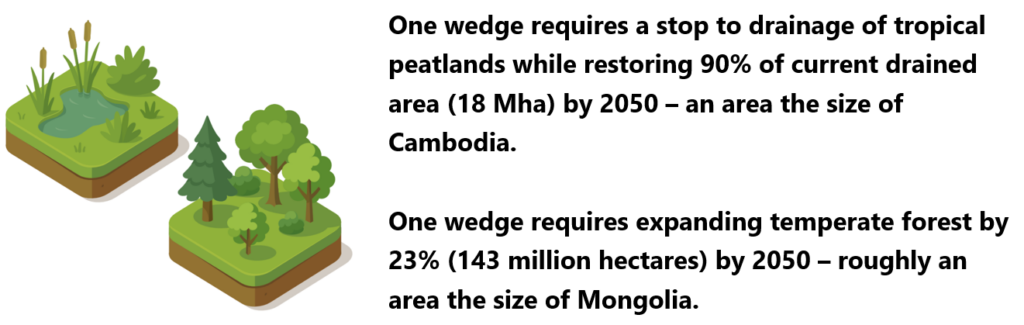
The study finds that one full wedge can be achieved by halting the drainage of tropical peatlands and restoring 90% of currently drained tropical peatland area by 2050 — around 18 million hectares, roughly the size of Cambodia. That level of mitigation is equivalent to many other headline-grabbing interventions, but with a far smaller land footprint than alternatives such as large-scale forest expansion.
This matters because peatlands are one of the planet’s most carbon-dense ecosystems. When left wet and intact, they store vast amounts of carbon. But once drained for agriculture, forestry or other land uses, peat soils begin to oxidise and release that carbon into the atmosphere, turning long-term carbon sinks into major sources of greenhouse gas emissions. Rewetting degraded peatlands is therefore essential to stop these emissions, reduce fire risk and begin the process of ecological recovery.
As Dr Nathan Johnson, Research Associate at Imperial College London and one of the paper’s authors, said: “Peatlands cover only a few percent of Earth’s land, yet they store twice as much carbon as all the world’s forests. When land footprint is an important bottleneck for climate action, protecting and restoring peatlands is one of the most powerful ways to cut emissions without competing for vast areas of land.”
Responding to the paper, Eva Hernandez, Global Peatlands Lead for Wetlands International said: “Peatlands are the world’s unsung climate champions. We’ve been banging away about their huge mitigation potential for years and this paper shows clearly why governments, businesses and funders should invest in safeguarding and restoring healthy peatlands. As an added bonus, wet, healthy peatlands also enhance water security, reduce wildfires, mitigate floods and drought, and boost unique biodiversity.”
The paper comes out just ahead of the launch of the Peatland Breakthrough, a major global initiative to accelerate investment and scale up action in peatlands – and provides a clear climate rationale for countries and companies to pledge their support.
The paper is especially important in a policy landscape where climate discussions often centre on high-profile technologies such as battery storage, nuclear power, carbon capture or direct air capture. The paper shows that many solutions with comparable climate impact look very different in practice — and that some of the biggest levers are hidden in plain sight.
For example, the study finds that reducing meat consumption by 30% has the same climate impact as cutting passenger air travel by 70%. It also shows that cutting food loss and waste by 51% would deliver one wedge, while nearly full decarbonisation of global cement production would be needed to achieve the same effect.
These comparisons reveal the scale of action required, but also make clear that there is no single route to a safer climate future. According to the paper, around 20 wedges are needed to keep 1.5°C within reach relative to current policies, and there are more than 6 trillion possible combinations of strategies that could together deliver that outcome.
Alongside the paper, the researchers have launched climatewedges.com, an interactive online tool that allows people to build their own decarbonisation pathways and compare options across sectors including energy, transport, food, buildings, industry and land use.
Dr Johnson said this is precisely the point: climate action should not be reduced to a single technocratic plan. “People should have agency over how they live and what they vote for, but must be able to compare options to do so,” he said in the press release accompanying the study.
For peatlands, this framing is powerful. It shows that rewetting and restoration are not niche conservation measures, but central climate strategies that deserve far greater attention and investment. They can cut emissions immediately by stopping further degradation, while also delivering co-benefits for water security, livelihoods, resilience to fire and drought, and biodiversity.
The study also serves as a reminder that climate mitigation portfolios are not automatically additive: some strategies compete for land, biomass, materials or clean electricity. That makes peatland restoration even more compelling. Compared with many land-based options, it offers disproportionate returns from relatively small areas.
As governments refine their climate plans and societies debate which pathways are fair, feasible and effective, this new “wedge” framework offers a clearer way to understand the choices ahead. And for those choices to be credible, peatlands must be part of the picture.
Restoring and rewetting peatlands is not only one of the most effective ways to avoid emissions from degraded landscapes and slowly sequester carbon from the atmosphere. It is also one of the clearest examples of how nature-based solutions can deliver climate impact at scale.