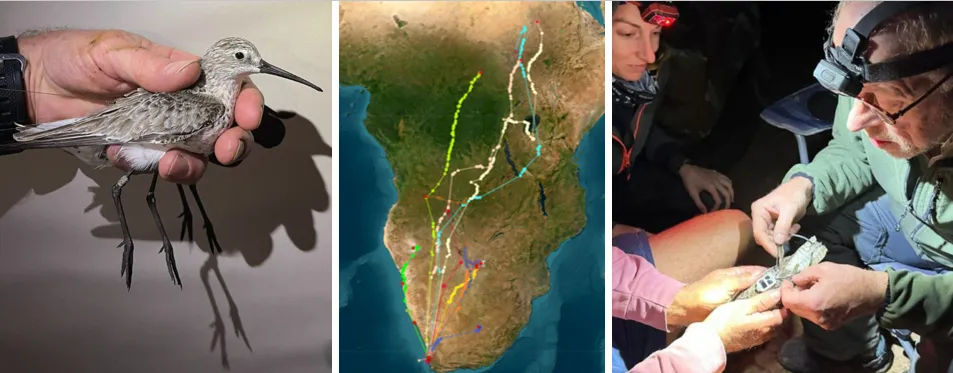

Astonishing flight by one of our migrating Curlew sandpipers
60g bird flies non-stop for 60 hours across Africa covering 3,870km
Sometimes nature just makes you shake your head in awe. For the first time ever, we are tracking 20 Curlew sandpipers in partnership with Birdlife South Africa as they migrate north to the Artic tundra from the southern tip of Africa. It is a remarkable journey for all of them. But one of them – known as Delta – just did something truly astonishing.
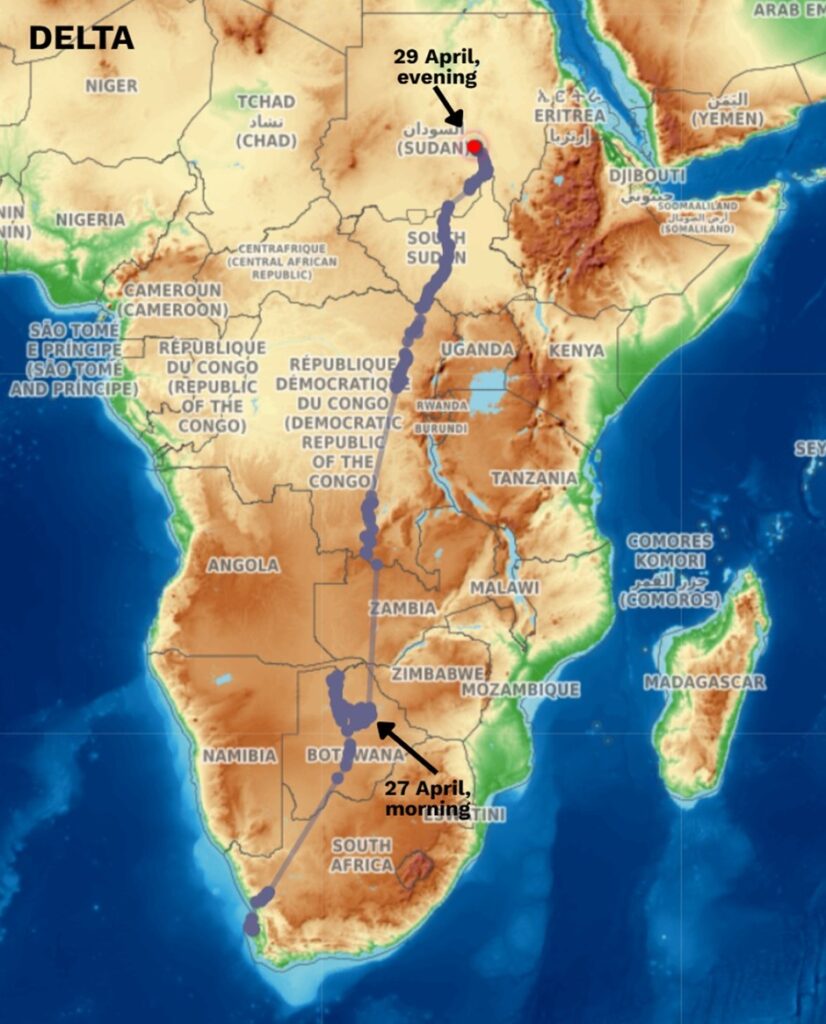
Having started his migration from South Africa in early March, Delta spent 1.5 months in the Makgadikgadi Pans in neighbouring Botswana – before embarking on an epic flight.
Early on April 27, he set off, flying north over Zimbabwe, Zambia and crossing the border of the Democratic Republic of Congo (DRC) in early afternoon. By late evening, he was already deep into DRC and still going strong – heading for South Sudan.
On April 28, he crossed the border and around midnight he reached the southern end of the Sudd Marshes in South Sudan – one of the continent’s most iconic wetlands and a Key Biodiversity Area. Several of our other tagged Curlew Sandpipers have stopped in the region to rest and refuel, but Delta keep on flying.
By 0800 on April 29, he had overflown the vast Sudd region and was already in Sudan, moving in the direction of the White Nile valley.
Where he finally landed after noon – some 60 hours and 3870 km north of his departure point.
That’s a 60g bird flying non-stop for 60 hours at an average speed of 64.5 km/h. Wow!
You can follow Delta and the other migrating birds via this Whatsapp channel (see below), where we are providing daily updates on their journeys.

——–
Delta is one of 20 Curlew sandpipers and 3 Grey plovers that are being tracked during their annual migration. The tracking aims to provide a better understanding of their migration & the sites they depend on to rest & refuel within the African-Eurasian Flyway. And so enhance conservation efforts.
Led by Birdlife South Africa, the project involves strong international collaboration with Wetlands International, the Department of Ornithology at the Max Planck Institute for Biological Intelligence (Germany), FitzPatrick Institute of African Ornithology (University of Cape Town), and Conserve Eden (Plettenberg Bay). Funding has been provided by the Royal Society for the Protection of Birds and the Ecological Restoration Fund.
Find out more about the project here