
60 years of the International Waterbird Census

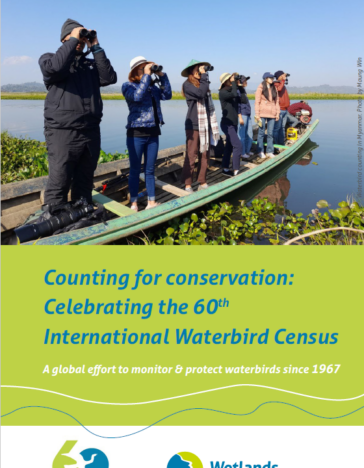
Every year since 1967, tens of thousands of people have stepped into their local wetlands — from icy lakes to tropical intertidal flats — to take part in the International Waterbird Census (IWC). From coastal areas in northern Europe to tropical estuaries in Asia and Africa, volunteers and professionals alike join this global citizen science effort dedicated to tracking the health of waterbird populations and the wetlands they depend on.
A Global Effort with Lasting Impact
What began as a regional survey 60 years ago has become one of the world’s most important sources of knowledge about waterbirds and wetlands. The information collected through the IWC guides real conservation action — protecting wetlands, shaping international policy, and caring for millions of waterbirds around the world. The objective of the census are to:
- Estimate waterbird population sizes and trends
- Identify and monitor priority sites for waterbirds
- Support wetland conservation and management planning
- Inform global and regional agreements and national policies with waterbird status and trend data
- Encourage citizen participation in waterbird and wetlands conservation
Why count waterbirds?
Waterbirds are highly visible and occur across a wide variety of wetlands worldwide. They are also charismatic and important in ecosystem functioning. As early as the beginning of the 20th century, it was recognised that these birds could only be conserved and sustainably managed through international collaboration. At the same time, waterbirds captivate amateur birdwatchers and are relatively easy to count. This makes them ideal for long-term monitoring: cost-effective to survey year after year, largely through a volunteer network.
What we’ve learned: 60 years of trends
- Conservation efforts pay off: Protection and management have helped certain species bounce back. Several goose species in Europe have increased thanks to coordinated
conservation and sustainable harvest management. - But many are in decline: Particularly, waders show worrying downward trends, reflecting the pressures on wetlands, grasslands and tundra habitats along their flyways.
- Waterbirds are responding to a changing world: Globally, waterbird distributions shift with temperature in temperate zones and rainfall in the tropics. By 2050, suitable wintering areas in Europe are predicted to extend northeastwards into the Baltic and southern Russia, while
ranges in Africa may become increasingly fragmented.
By detecting declines in hunted species, tracking the impact of climate change and avian influenzia, the data from the IWC is essential for guiding waterbird conservation policy and action.
Conservation impact
The IWC data is directly used in conservation frameworks:
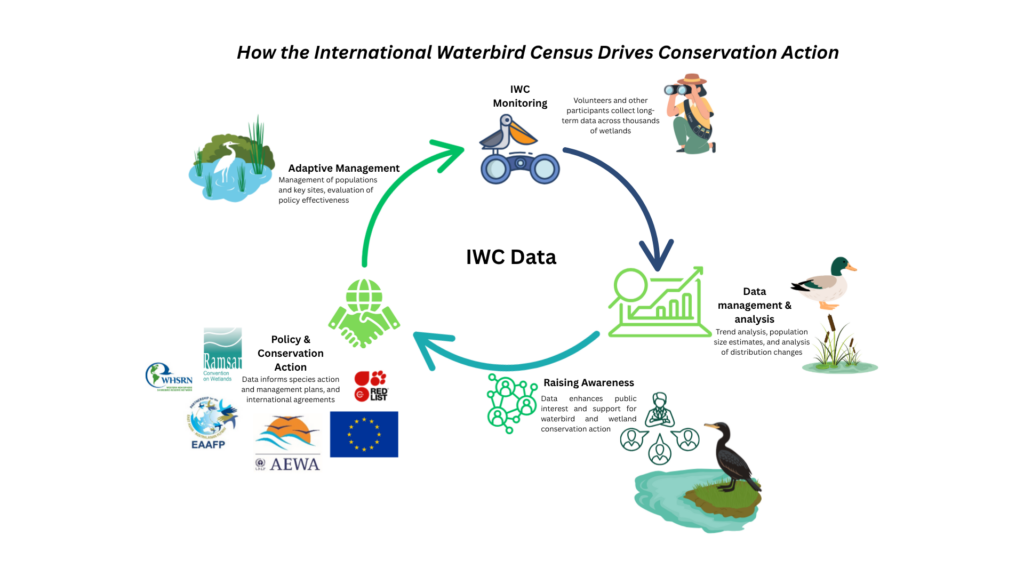
- The Ramsar Convention on Wetlands: Local counts provide the evidence for identifying Wetlands of International Importance, and the population estimates derived from the counts are the basis for setting the 1% thresholds for the application of Ramsar Criterion 6. The IWC has helped designate 956 Ramsar sites, covering 1.5 million km2 – the size of Mongolia.
- African-Eurasian Migratory Waterbird Agreement (AEWA): It contributes to classifying waterbird populations in Table 1 of the Agreement, which determines the rules for their conservation and management. In addition, it serves as a basis for many of the success indicators of AEWA’s Strategic
Plan. - East Asian-Australasian Flyway Partnership (EAAFP): Identifying internationally important sites for migratory waterbirds for designation as EAAF Network Sites, currently nearly 160 sites in 19 countries.
- Convention on Migratory Species (CMS): monitoring the status of migratory waterbirds and their habitats.
- Convention on Biological Diversity (CBD): addressing the goal in conservation and sustainable use of biodiversity under the Kunming-Montreal Global Biodiversity Framework (GBF).
- Important Bird Areas (IBAs): 2,701 IBAs have been identified partly using IWC counts, covering 1.75 million km2 – roughly the size of Libya or Mexico.
- Special Protection Areas (SPAs): 2,721 SPAs across European Union were identified based on IWC data, covering 418,000 km2 – an area larger than Germany.
- World Heritage Sites: monitoring the status of waterbirds and their habitats.
Driving science & action
IWC has become one of the most powerful datasets for biodiversity science:
- Flyway trends: Multi-species indices generated from the IWC data depict the overall change of waterbirds and provide headline indicators for the EU Birds Directive, AEWA and EAAFP.
- Waterbird Population Estimates (WPE): IWC counts form the backbone of these estimates,
which guide the identification of key sites for waterbirds under the Ramsar Convention on
Wetlands, AEWA, the EAAFP and the EU Birds Directive. - Red Listing: IWC population trends and distribution data are a major source for IUCN Red List of
Threatened Species assessments of waterbird species. - Climate change: Analyses of IWC counts have demonstrated the shift of winter distribution of
waterbird species and support flyway-scale climate change adaptation planning to ensure
that the protected area network can accommodate it. - Protected areas: IWC data has demonstrated how well-managed protected sites can stabilise populations, while poorly managed ones often fail to prevent declines.
- Prioritisation of sites for conservation and management: IWC data has been integral in identifying and prioritising internationally important sites for investments by government and development agencies to develop and implement multistakeholder management plans.
- Fighting zoonotic disease: Since the first outbreaks of Highly Pathogenic Avian Influenza in wild birds in 2005, IWC data has provided valuable information to improve our understanding of the spread of the viruses between domestic poultry, humans and wild birds working with the UN Food and Agriculture Organization (FAO), Convention on Migratory Species (CMS), World Health Organization (WHO) and researchers.
Help Us Keep Watch Over the World’s Wetlands
The power of the IWC lies in its continuity. By repeating the same coordinated efforts year after year, it builds a long-term record that allows us to see beyond short-term fluctuations and understand real population trends. The IWC depends on people like you, those who care for our shared world and want to leave it thriving for future generations of people and birds. Your donation helps us:
- Train and support volunteers around the globe.
- Keep critical data flowing to guide protection efforts.
- Connect people to their local wetlands — and to each other.
More information
If you want to find out more about the IWC and its impact, here are some starting points:
- Be inspired by the stories of counters around the world
- Learn about the latest status of all the world’s waterbird populations
- Explore the annual national reports from the IWC
- Read much more about the history and impact of the IWC in our brochure
- Explore the work of our regional partners coordinating the census in the Caribbean, Central America, the Neotropics, Asia and Africa-Eurasia.
- Find the coordinator in your country and join the counts! The counts are organised in January across most of Africa, Asia and Europe and February in the Americas and Australasia.
Downloads
A list of blog articles


Contact
Tom Langendoen