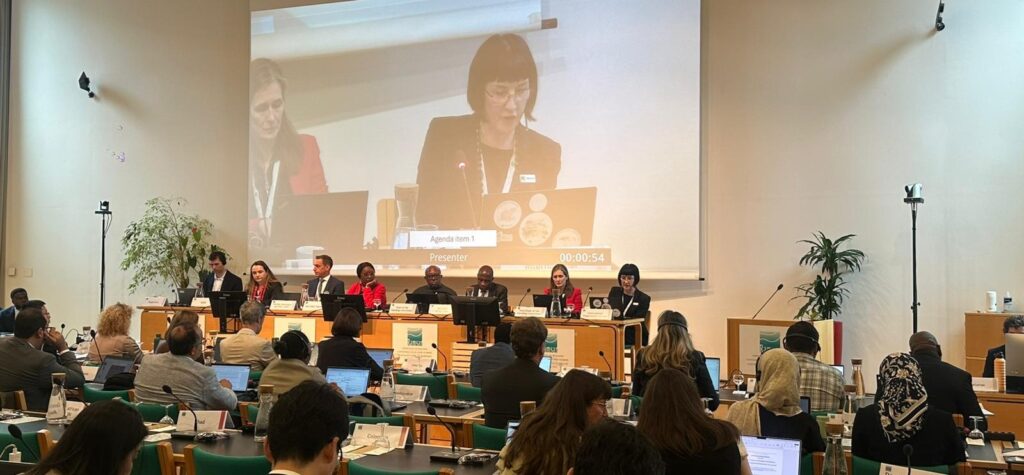

Partners detail key priorities for wetland action at Ramsar SC67
Statement given by Laura MacKenzie, Senior Advocacy Officer, Wetlands International in the opening session of the Convention on Wetlands Standing Committee 67 on behalf of all six International Organisation Partners – Birdlife International, IUCN, IWMI, Wetlands International, WWF & WWT.
The success of COP15 in Victoria Falls paves the way for countries to scale up the protection and restoration of wetlands; safeguarding the irreplaceable benefits they provide for people, nature and climate. We again thank Zimbabwe as COP president and we congratulate Panama as host of COP16.
With the adoption of the 5th strategic plan and many resolutions – on flyways, freshwater ecosystems, OECMs, and finance to name just a few – our focus is firmly on supporting implementation.
Informed by our collective work on the ground, in wetlands all across the globe, we would like to highlight three key priorities for action.
First priority: addressing the root causes of wetland loss and degradation: especially in finance and economic decision-making. Unlocking more funds for wetlands is a top priority for our work. Yet, the Global Wetland Outlook is clear: nature-negative public and private financial flows have increased. The UNEP State of Finance for Nature report reveals the shocking scale of this: for every dollar invested in protecting nature, thirty dollars are spent destroying it.
So, this triennium, more attention is needed on reducing and redirecting wetland-negative subsidies and financial flows.
As the IPBES business and biodiversity assessment reminds us: governments have a key role to play. Policy, legal and regulatory frameworks shape businesses and financial institution action. Fiscal policies and incentives can be aligned with biodiversity goals.
Rapid progress must also be made to incorporate the value of wetlands into economic policy. Too often, we still see wetland safeguards undermined rather than strengthened in the name of development.
For example, the recent weakening of a law protecting glacier areas worsens the threats posed by lithium mining to wetlands and water security in the High Andes; and the proposed dilution of the EU Water Framework Directive raises deep concerns.
Second priority: reconfiguring human-wetland relationships. We welcome several IUCN resolutions on the rights of nature, including rivers, adopted in October by governments, Indigenous Peoples Organisations, and NGOs.
We look forward to exploring how rights of wetlands approaches can contribute to transformative change: as highlighted by IPBES as essential, and as referenced in the Ramsar strategic plan
Third priority: establishing wetlands as vital to the delivery of other MEAs, and prioritising them as the critical watery connectors flowing through all three Rio COPs, and the UN Water Conference, pursuant to resolution XV.4 on synergies.
The UN SDG 6 Synthesis Report emphasises the importance of water as a Super Connector, across all conventions and SDGs, and wetlands are central to that.
2026 started on a positive note with Parties to the Convention of Migratory Species adoptin decisions on flyways, connectivity and migratory wetland species. The Pantanal Declaration championed the central role of wetlands -not just for biodiversity, but for climate regulation, water security, and community livelihoods. This showcases why cross-border cooperation and political leadership really matter.
Looking ahead, strengthening coherence of monitoring and reporting systems is essential. In this respect, we welcome the proposed indicator framework for the 5th strategic plan and encourage Standing Committee to adopt it.
UN CCD COP17 in Mongolia is an opportunity to accelerate action on freshwater ecosystems and peatlands in particular, building on the incorporation of wetlands into land degradation neutrality targets and drought resilience plans.
At CBD COP17 in Armenia we want to see the global review showcase how reversing wetland loss and degradation is critical to achieving the 2030 biodiversity targets.
At UNFCCC COP31 and the UN Water Conference, discussions on water security, climate resilience and mitigation must secure a major shift in investment from grey to green and blue infrastructure.
We also see a key role for ‘whole of society’ voluntary initiatives such as the Freshwater Challenge, as featured in resolution XV.15, the Mangrove Breakthrough and the Peatland Breakthrough. We warmly encourage more Contracting Parties to join.
Finally, we would like to highlight the exceptional value and importance of STRP outputs to the conservation and wise use of wetlands. We are pleased to contribute to many priority tasks, not least on GEOwetlands; the water cycle; transformative change pathways; and the next Global Wetland Outlook on cities.
We look forward to collaborating with Contracting Parties, the secretariat and many others, this week and beyond, towards our shared wetland goals.