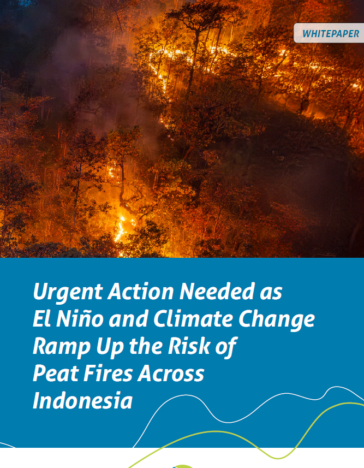

White paper: Urgent Action Needed as El Niño and Climate Change Ramp Up the Risk of Peat Fires Across Indonesia
Indonesia is facing the growing threat of severe peat fires in the coming months as a new El Niño combines with higher temperatures, increased fertiliser prices and ongoing degradation of peatlands. Another wave of vast peat fires would threaten people in local communities and distant cities as well as economies, biodiversity and climate action.
Wetlands International is calling for urgent action to reduce short-term risks while also outlining medium-to-long-term solutions to strengthen peatland resilience. All the signs are pointing towards another potentially devastating peat fire season in Indonesia. Governments, land managers, civil society organisations, companies and donors in Indonesia and beyond have a small window of opportunity to invest in effective measures to mitigate the risks to people, nature and climate – before it is too late.
SHORT TERM SOLUTIONS:
Act now to ensure existing systems and infrastructure are operational, identify high risk areas, and increase water levels, at least temporarily.
- Re-assess all key services and ensure they are operational including information sharing, early warning services, meteorological services, hydrological monitoring, fire prevention, detection and control, and local and regional communications channels;
- Identify the most fire prone areas;
- Update fire contingency plans and define clear coordination mechanisms and roles among the authorities, services and communities;
- Ensure rewetting infrastructure is fully operational;
- Request stewards of the land in the most fire prone areas to block drainage canals to keep more water in peatland areas;
- Explore flexible emergency financing mechanisms within existing regulatory frameworks to ensure funding can be readily available to implement these essential actions, including legally reallocating funds from long-term development to these short-term measures;
- Request local authorities to re-activate simple community-based early warning
systems. Encourage communities to take measures and strengthen fire prevention awareness; - Establish fire task forces in fire-prone areas.
MEDIUM AND LONG-TERM ACTION
While it is imperative to take short term measures to reduce the risk of another wave of peat fires across Indonesia, it is also important to take a longer-term view and invest in protecting, restoring and sustainably using the country’s vital peatlands to build resilience to future fires as well as enhance water and food security, reverse nature loss and accelerate climate action. These medium and long-term actions will also help Indonesia achieve its national targets under the Paris Climate Agreement (UNFCCC), the Global Biodiversity Framework (Convention on Biological Diversity) and the Sustainable Development Goals.
- Scale up peatland rewetting and restoration by blocking channels and reducing water escaping from the peatland areas and re-introducing native species. Permanently increase water levels in peat in productive areas and promote sustainable peatland management standards;
- Monitor and evaluate impacts of existing rewetting initiatives;
- Develop paludiculture and/or other peatland-friendly economic activities and market;
- Develop Ecosystem-based Disaster Risk Reduction initiatives;
- Promote and reinforce implementation peatland management best practices with no peatland burning, as part of community efforts;
- Strengthen community preparedness by establishing and training Community Fire Brigades (Masyarakat Peduli Api, MPA), conducting regular exercises, enhancing fire prevention awareness, and developing community-based early warning systems, peatland monitoring systems and participatory patrols, especially in fire prone areas;
- Ensure dedicated and sustainable funding for peatland restoration by encouraging the use of a broad set of funds and financial mechanisms, including regional government budgets, special allocation funds, corporate social responsibility, climate finance, blended finance, philanthropy, Payment for Ecosystem Services, village funds etc.
- Develop and implement a coherent policy on peatland management and integrate different policy
portfolios, including food security, water management, disaster risk management and health. Maintain a (spatial) knowledge base with up-to-date, site-level, empirical, and actionable information relevant to the different stakeholders and financing mechanisms operating in peatland landscapes; - Prevent further drainage of remaining close-to-natural peat-swamp forests;
- Strengthen accountability mechanisms in line with existing legal frameworks so that land-use rights can be reviewed and, where warranted, revoked when concession holders fail to steward land effectively (such as enabling peat fires);
- Invest in ecological restoration of permanently unproductive peatlands towards swamp forest
ecosystems.