

Safeguarding Peatlands
Life on Earth as we know it wouldn’t be the same without peatlands, and still they are probably one of the less understood and monitored ecosystems globally.
Peatlands are the planet’s biggest terrestrial carbon store, permanently locking up carbon as long as they remain wet. Despite covering only 3% of the world’s land area, peatlands contain around 30% of terrestrial carbon (500GT) – more than twice as much carbon as all the world’s forests biomass.
Carbon is not the only thing peatlands hold: they are also natural water sponges, acting as water supply for communities. A global assessment estimated that peat-rich catchments supply drinking water to around 71 million people. Peatlands also contribute to disaster risk reduction and climate adaptation by regulating water storage and flow across landscapes, buffering floods and droughts. They also provide food, fish, livestock forage, fuel and other products. Peatlands, thus, provide essential services that directly underpin human well-being and local livelihoods.
Peatlands are also biodiversity hotspots, hosting species adapted to their unique conditions, from tiny mosses or orchids to large trees, from the smallest fishes and dragonflies to tigers, orangutans, gorillas or elephants, not to mention a large cohort of migratory birds and even marine mammals.
Yet, we have been degrading them for centuries for peat extraction but mostly draining them for agriculture, forestry and grazing. It is estimated that we have lost around 15-18% of peatlands worldwide. Drained peatlands oxidize, release carbon and can burn and sink, increasing the risk of haze, and flooding and saltwater intrusion. Degraded peatlands emit around 5% of global anthropogenic greenhouse gas emissions – as much as aviation and shipping combined.
And we are still losing peatlands at an alarming pace – around 500,000 hectares per year. Meanwhile, climate change is increasing pressure on boreal and sub-Arctic peatlands, while also reducing the chance that degraded peatlands can recover. Action is, thus, urgent.
Our strategic approach to safeguarding peatlands
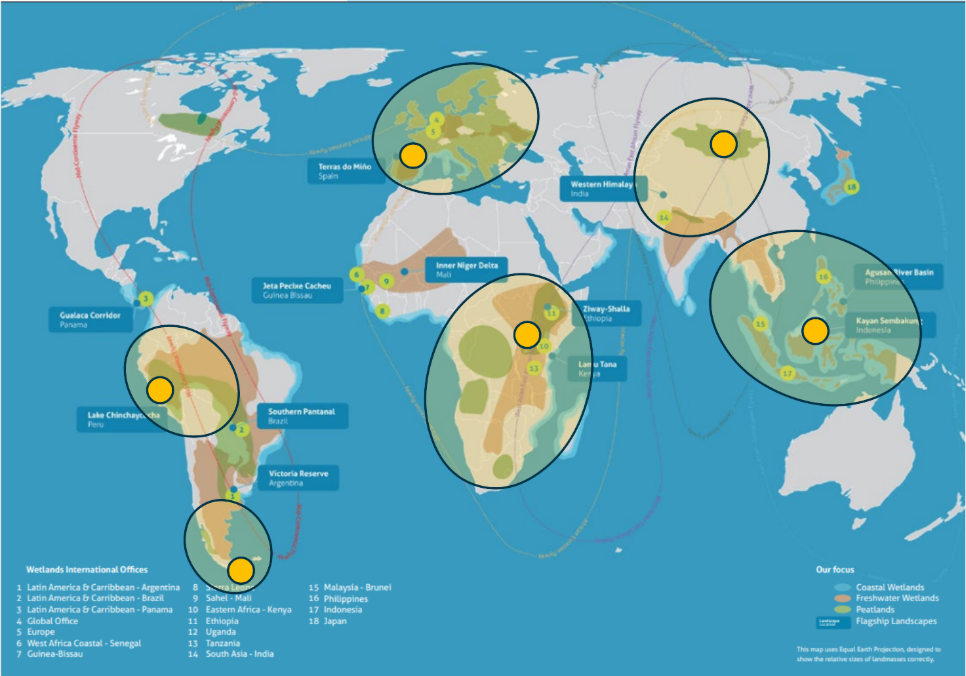
From sites to regions: We implement projects on the ground with local partners, co-creating with local communities and other local stakeholders to ensure long-term sustainability of interventions. We also consider whole landscapes to identify or create upscaling mechanisms to drive systemic change. This way we conserve, restore, manage and slow down further degradation of flagship landscapes (see below) and other priority regions.
Building a movement: We are developing and coordinating the Peatland Breakthrough with partners as a global call to action and vehicle for scaling up peatland conservation, restoration and wise use. Through a whole-of-society approach, the Peatland Breakthrough aims to broaden the peatlands movement and engage actors that have not traditionally been part of the conversation, including farmers and other land users, alongside governments, companies and investors.
Strengthening the knowledge base: We work with partners to improve the quality and availability of peatland data, including mapping and inventorying peatlands, especially where it is most needed, in Latin America and Africa. We improve hydrological modelling and monitoring. We also explore new ways of farming or livelihood development that keep peatlands wet (such as paludiculture) and better ways to restore peatlands and their biodiversity values. We investigate how to quantify and measure carbon storage in peatlands’ soils, as well as improve the understanding and measurement of peatland greenhouse gas emissions and removals in specific locations.
Integrating peatlands in policies: We will work with our partners and network to ensure that peatlands are better recognised and integrated across relevant climate, biodiversity, water, agriculture, land-use and restoration policies and plans, at global and national levels, building on our engagement under relevant MEAs to strengthen the inclusion of peatlands in national commitments and plans, such as NDCs, NBSAPs, and LDN. We will work on strengthening the enabling policy environment for peatland conservation, restoration, rewetting and wise use.