

Guinea Bissau adopts a Shared Vision to protect nature and strengthen communities in the Jeta-Pecixe-Cacheu landscape
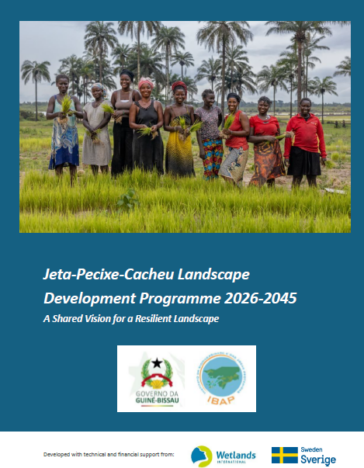
Guinea Bissau has taken a major step towards the long-term conservation and sustainable development of the the Jeta-Pecixe-Cacheu (JPC) landscape with the signing of the JPC Landscape Development Programme 2026–2045, supported by Wetlands International.
This institutional commitment was signed by Ms Aïssa Régala de Barros, Director-General of the Institute for Biodiversity and Protected Areas (IBAP), and Ms Honorina Vasconcelos, Governor of the Cacheu region, under the leadership of Mr Ibrahima Thiam, Executive Director of Wetlands International West Africa.

Home to 245,000 people, the Jeta-Pecixe-Cacheu landscape is an exceptional part of Guinea-Bissau’s natural and cultural heritage. Covering 446,731 hectares, its extensive mangroves, estuaries, forests and wetlands sustain livelihoods, fisheries, climate resilience and cultural identify, while supporting rich biodiversity including waterbirds, the West African manatee, and Atlantic humpback dolphin.
These values are however increasingly affected by interacting pressures, including unsustainable resource use, land-use change, growing development and infrastructure, and the impacts of climate change. Fragmented planning, uneven capacities and dependence on short-term project finance further constrain the ability of individual initiatives to achieve lasting impact at landscape scale. Addressing these pressures requires cooperation beyond individual protected areas, sectors and projects.
Developed as part of the Wetlands for Resilience (W4R) initiative, with support from the Swedish International Development Cooperation Agency (Sida), the JPC Programme provides a long-term shared strategic framework and vision for the next two decades. It aims to strengthen ecosystem conservation, promote the sustainable management of the region’s natural resources, support resilient livelihoods and mobilise long-term financing.
The programme is the result of a broad and participatory process led by the JPC Landscape Stakeholder Platform, involving public institutions, local communities, civil society, academic institutions and development partners. It is built around five priority areas: governance; communication and environmental education; conservation and restoration; sustainable livelihoods; and financing.
The programme sets out a shared ambition and priorities for the JPC landscape: to create a resilient landscape where biodiversity conservation, sustainable development and community wellbeing can advance hand in hand.
The signing also marks an important step in the ongoing process towards UNESCO Biosphere Reserve designation for the Jeta-Pecixe-Cacheu landscape. By reinforcing political and institutional commitment, the agreement provides further momentum for this ambition.
Cross Border coastal zone agreement Guinea Bissau-Senegal
In addition, on 2 October, the Minister for the Environment and Climate Action of Guinea Bissau and the Minister for the Environment and Ecological Transition of Senegal signed a Senegal–Guinea-Bissau cross-border cooperation agreement to strengthen their cooperation in support of the conservation and integrated management of the Cacheu–Basse-Casamance cross-border coastal zone. The aim of this agreement is to contribute to the creation of a cross-border biosphere reserve: a step forward for the conservation of connected landscapes. More information
Downloads
Ibrahima Thiam