

Hard to Top(e): Big win for tope sharks after long campaign
By Irene Kingma, Strategy and Policy Lead, Dutch Elasmobranch Society (and my day job as Senior Technical Officer, Coasts and Deltas at Wetlands International)
These are the two questions I am asked most frequently when I tell people that I work in shark conservation in The Netherlands: “Are there sharks in the North Sea?” and “Why do sharks need protection?” There’s no species that provides better answers to these questions than the tope shark.
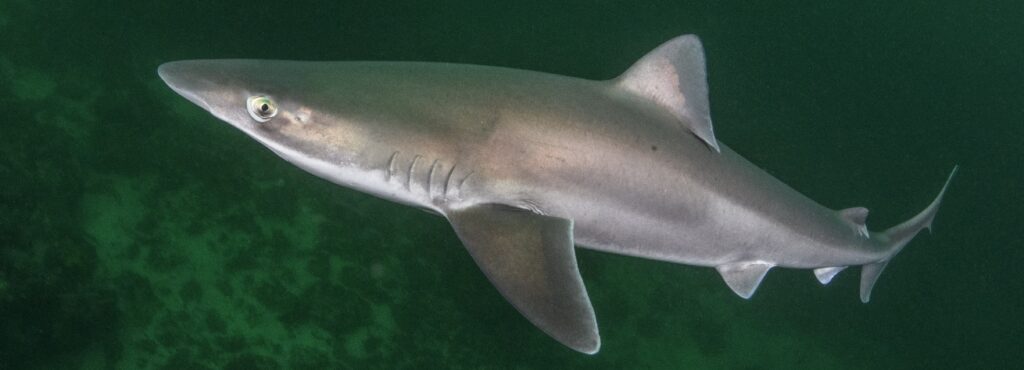
These beautiful 1,5-meter-long sharks feed on herring and mackerel, and migrate into the North Sea to have their young. Like most sharks, they give birth to live pups and to keep them safe, they swim close inshore, where the sheltered coastal waters offer greater protection for the pups. I have studied this migration first hand, working with partners on an amazing project during which we tracked female tope sharks all the way from the Azores in the Atlantic Ocean back into the Wadden Sea and the Oosterschelde in the Dutch delta to have their pups. Due to this research, we can now confidently say that the Dutch delta is a vital area for the species.
You may not believe it but baby tope sharks are incredibly cute, with big eyes and tiny fins. It’s always a joy to see them come back in summer.
Unfortunately, what has also become clear is that there are fewer coming back in summer. The tope shark is now one of the most endangered sharks in Europe. They take 15 years to mature and only have pups once every three years. This makes them very vulnerable to fishing pressure as populations can easily be decimated and they can only recover very slowly. As it is a popular shark for human consumption – caçon, a tapas dish from Spain and Portugal, is made with tope for example – there has been a targeted tope fishery, which had led to a population decline of over 80% over the past 3 generations. They are therefore now classed as Critically Endangered on the IUCN Red List.
Ever since I started working on shark conservation in 2008, tope has been a focus species for urgent conservation action. But at least within the EU, there was no political will to take any action.
In 2021 this led me to try an unexpected method to convince decision makers to think otherwise. At a shark conference in The Netherlands, I did not present another PowerPoint with graphs highlighting population declines. Instead, I brought my ukulele and sang a song (to the tune of Hotel California by the Eagles) about the plight of tope. This was of course entertaining for my fellow shark scientists, who sang along with vigour, but it also spurred decision makers in the room to add one line on tope into the Dutch Shark Action Plan, which was linked to the Convention on Migratory species (CMS) – where tope had been listed for conservation action the previous year.
I’m guessing that you might not have heard of the CMS. Most people haven’t. Which is a pity since it is a critically important UN environmental treaty to conserve migratory species across their range. Indeed, it is the main UN biodiversity framework aimed at protecting species that cross national boundaries and ensuring habitat connectivity: strongly complimenting the Convention on Wetlands mission to protect wetland species and the networks of wetland ecosystems they rely on, including through international cooperation. This is vital not only for specific species of birds, fish, mammals and other migratory species, but also because these keystone species are indicators of the health of their ecosystems, which so many other species and human communities depend on.
Migratory species can be listed on two CMS appendixes: Appendix 1 for species the require strict protection and Appendix 2 for species that require cross boundary action to prevent further decline. It was the second of these – Appendix 2 – that the tope was listed on in 2020, which opened the door (at long last) for countries to start doing what was needed.
I was lucky enough to participate in the CMS Conference of the Parties (COP14) held in 2024 in the historic Uzbek city of Samarkand. Thousands of kilometres from the sea, my shark colleague Dr Paddy Walker and I worked with the Netherlands delegation on an EU proposal for an action plan for tope that would hopefully be adopted at the next CMS conference in the Brazilian town of Campo Grande. This gave us two years to work with the EU and the other range states on a plan that addressed all the barriers to effective management of tope. The Netherlands was a strong ally in this work as they ensured all national governments were consulted and relevant EU working groups singed off on it.
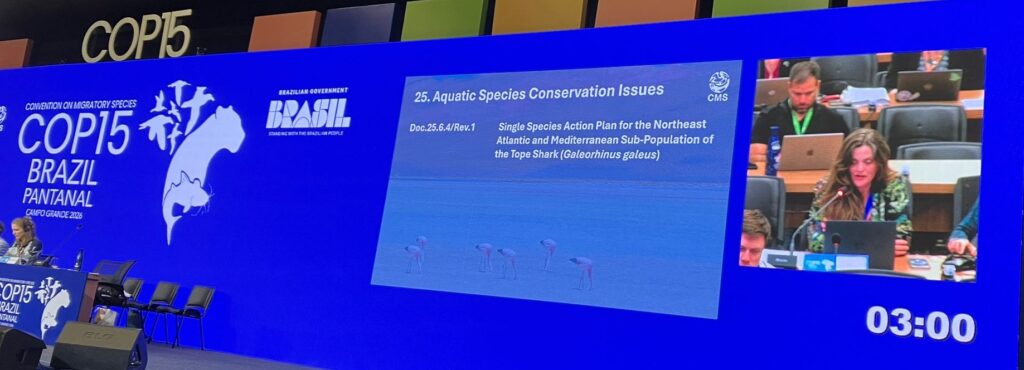
And so, on March 25th this year, all our years of work came to fruition. In the plenary hall of COP15 in Campo Grande, I watched as all the Contracting Parties endorsed the Single Species Action Plan (SSAP) for Tope Shark in the Northeastern Atlantic and Mediterranean. I’m sure that for almost everyone in the room, the moment passed in a flash. But for me time stood still as the Plan was put up the big screen, knowing that this could mean we would finally be able to deliver real change for tope. I had thankfully practiced my official statement to the plenary as I would have been lost for words otherwise.
Does this mean there is nothing more we have to do for tope now? Unfortunately not. The SSAP provides a strong basis for action but there are still big knowledge gaps for large parts of the population and competing interests in coastal zones make it difficult to implement protective measures there.
But we finally have strong, uniform commitment for the protection of this amazing species. And that’s certainly something to celebrate.
Find out more about other big wins for conservation at CMS COP15 in our diary from the conference.