Wetlands International at Climate COP31
9-20 November 2026 · Antalya Expo Center, Türkiye
As the climate crisis worsens, the world is finally waking up to the critical role of healthy wetlands as climate solutions. And the urgent need to scale up investment and action to protect and restore them.
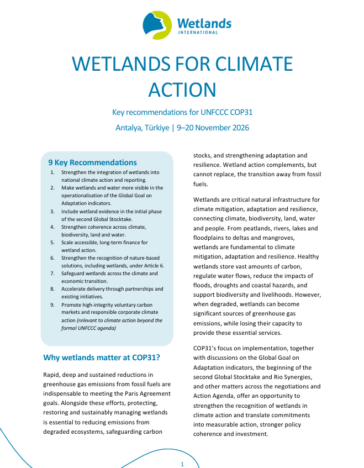
With temperatures and emissions rising and climate impacts intensifying, healthy wetlands stand out as one of our most effective yet undervalued allies for tackling the climate crisis. From mangroves to peatlands, rivers to seagrass beds, freshwater and coastal ecosystems are central to achieving global goals for climate mitigation, adaptation, and resilience.
This November, the world’s governments meet in Antalya for UNFCCC COP31. Nearly 200 countries and the EU are expected, with leaders joining on 11-12 November. We’ll be there to make sure wetlands are part of the answer.
Our delegation will further advocate for the inclusion of wetlands in NDCs and NAPs; speak at various events raising awareness of the importance of wetlands for climate; deepen collaboration with governments, coalitions, funders and partners (especially those involved in the Mangrove Breakthrough and the Freshwater Challenge); and launch the Peatland Breakthrough.
Why Wetlands Matter at COP31
Rapid, deep and sustained reductions in greenhouse gas emissions from fossil fuels are indispensable to meeting the Paris Agreement goals. Alongside these efforts, protecting, restoring and sustainably using wetlands is essential to reducing emissions from degraded ecosystems, safeguarding carbon stocks, and strengthening adaptation and water resilience. Wetland action complements, but cannot replace, the transition away from fossil fuels.
Wetlands connect climate, biodiversity, land, water and people. From peatlands, rivers, lakes and floodplains to deltas and mangroves, wetlands are fundamental to climate mitigation, adaptation and resilience. Healthy wetlands store vast amounts of carbon, regulate water flows, reduce the impacts of floods, droughts and coastal hazards, and support biodiversity and livelihoods. However, when degraded, wetlands can become significant sources of greenhouse gas emissions, while losing their capacity to provide these essential services.
COP31’s focus on implementation, together with discussions on the Global Goal on Adaptation indicators, the second Global Stocktake and Rio Synergies, among other matters being discussed in the negotiations and in the Action Agenda, offer an opportunity to strengthen the recognition of wetlands in climate action and translate commitments into measurable action, stronger policy coherence and investment.
Wetlands International Key Messages
- Wetlands are fundamental to climate mitigation, adaptation and water resilience: Healthy wetlands store vast amounts of carbon, regulate water flows, help reduce the impacts of floods, droughts and coastal hazards, and strengthen the resilience of ecosystems, communities and livelihoods.
- Wetlands connect climate, nature, water and people: COP31 focuses on Rio Synergies, as wetland action within wider landscapes can deliver multiple benefits for climate, biodiversity, water security, disaster risk reduction and livelihoods. Strengthened collaboration between climate/Rio Convention and Convention on Wetlands focal points at national level can enhance implementation.
- Wetlands need greater recognition, investment and implementation at scale: Stronger consideration of wetlands is needed in NDCs, NAPs and other national planning and implementation frameworks. The Freshwater Challenge, Peatland Breakthrough and Mangrove Breakthrough can help turn ambition into implementation at national and landscape level.
- Safeguarding wetlands across climate action: Wetlands conservation and restoration require safeguards and integration of wetland and water considerations across the energy transition, agriculture, infrastructure and other sectors. This is also in line with KMGBF (Target 8), which countries have already agreed to.
Find us at Our Events and Engagements in COP31
11 November
Water Resilience from catchment to cities: Proof of progress and solutions on water climate action
Location : GCA Special Event Room 4 – Perge
Time : 9:00 – 10:30 AM
Organizer : Axis 4 Building Resilience for Cities, Infrastructure, Water- Marrakech Partnership
The event highlights the implementation pathways bridging upstream water resource management with urban climate adaptation. Hosted within the Global Climate Action (GCA) Hub, the session serves as a core platform for demonstrating how global climate pacts, translate into measurable regional, national, and local infrastructure developments.
From Plans to Delivery: Building Resilience for Cities, Infrastructure and Water
Location : GCA Special Event Room 1
Time : 3:00 – 4:30 PM
Organizers : Axis 4 Building Resilience for Cities, Infrastructure, Water- Marrakech Partnership
This event will serve as the flagship space at COP 31 for the Axis to reflect on progress, discuss priority challenges and opportunities, and explore cross-sectoral nexuses and synergies that can help strengthen implementation efforts under the axis and related COP 31 priorities.
Water, Peace, and Security
Location : Water for Climate Pavilion Event
Time : 12:15 – 1:30 PM
Organizers : Water, Peace and Security (WPS) Partnership and Working Group on Water, Security and Health (Deltares, Kurdistan Regional Government, Wetlands International, Geneva Water Hub)
This event will explore how water cooperation can strengthen climate resilience and contribute to peace, drawing on experiences from Iraq, Kenya and India. It will highlight lessons from local initiatives and identify opportunities to integrate water, peace and security into global climate policies and action.
12 November
Advancing Blue Carbon in Indonesia: From MRV to High-Integrity Climate Action
Location : Turkiye Pavilion (Blue Zone)
Time : 11:10 – 12:00 PM
Organizer : Global Green Growth Institute
The session will present Indonesia’s evolving blue carbon MRV system, its role in supporting NDC and Carbon Economic Value implementation, and how the marine and fisheries, environment, and forestry sectors complement each other in transparent accounting. It will also cover methodologies, data requirements, the potential of AI and other emerging technologies, and international knowledge exchange to advance high-integrity blue carbon action. Wetlands International will have a speaker in this event.
13 November
Water Cooperation for Climate Resilience and Peace (Closed-Door roundtable)
Location : IOM pavilion, COP31 Blue Zone
Time : 12:00 – 1:00 PM
Organizers : WPS Partnership and IOM
This closed-door roundtable will consider how water can be leveraged as an entry point to sustain climate and peace engagement across COP cycles, keep momentum high, and accelerate finance and solutions through voluntary action, partnerships and finance outside formal negotiations. This roundtable aims to connect local experience to longer-term global engagement.
Integrating nature into coastal infrastructure: From solutions to decisions
Location : Qatar Pavilion
Time : 2:00 – 3:00 PM
Organizers : Qatar Free Zones Authority (QFZ), Earthna
This panel will move beyond showcasing individual solutions to address a more practical question: how should infrastructure owners decide which approach is appropriate, where, and under what conditions? Drawing on international port and coastal infrastructure experience, speakers will examine performance, operational requirements, costs, ecological outcomes, evidence needs and the conditions required to scale successful approaches.
COP31 Presidency High-Level Reception: Financing the Implementation of the Ocean-Climate Action through the Marine Conservation Breakthroughs
Location : Goals House, on Finance Day
Time : 4:00 – 5:30 PM
Organizers : CCT, COP30 Presidency of Brazil, COP31 Co-Presidencies of Türkiye and Australia, Mangrove Breakthrough, Coral, Seagrass, Saltmarsh and Kelp Breakthroughs
This high-level invitation-only reception will convene political leaders, government representatives, international institutions, financial institutions, development partners, civil society and scientific leaders to build consensus around the actions needed to finance for the implementation of the Marine Conservation Breakthroughs.
14 November
Accelerating Finance for Climate & Nature Action, featuring the launch of the Peatland Breakthrough
Location : Room Blue
Time : 1:15 – 2:45 PM
Organizers : Wetlands International, CAF, GEC, MSF
The launch of the Peatland Breakthrough, a 2030 Climate Solution under the Marrakech Partnership, marks the start of its implementation phase and an urgent call to mainstream peatlands as a global climate solution by 2030. This 90-minute high-level dialogue brings together governments, multilateral development banks, the private sector, and international partners to explore how integrated ecosystem investment can advance NDCs, NBSAPs, LDN targets, and the Ramsar Strategic Plan.
Unsustainable sand mining is undermining climate resilience
Location : Panda Pavilion
Time : 13:00 – 14:00 PM
Organizers : WWF, Wetlands International, UNEP
Sand and gravel are essential to infrastructure and economic development. Yet in rivers, floodplains, deltas and coasts, dynamic sand and sediment processes also sustain biodiversity, fisheries, freshwater resources, livelihoods and natural protection against climate-related hazards. Building on UNEP’s 2026 Sand and Sustainability report and experience from Southeast Asia, this session will explore how improved sand governance can support development needs while strengthening climate adaptation, ecosystem resilience and disaster risk reduction
Resilient Coastal Futures: Scaling Research and Innovation into Local Implementation Pathways
Location : WGEO Pavilionn
Time : 16:00 – 17:00 PM
Organizers : MENA Oceans Initiative by Goumbook in collaboration with the World Green Economy Organisation (WGEO).
The session will examine how scientific research, innovation and cross-sector partnerships can be translated into practical pathways for coastal resilience, particularly in regions facing increasing pressures on marine and coastal ecosystems. The discussion will bring together perspectives from science, policy and implementation, with a focus on bridging the gap between regional priorities and solutions that can be deployed and scaled. Wetlands International contributes with perspectives from a Mangrove Breakthrough lens.
16 November
Delivering Blue Climate Resilience: Aligning NDCs, Sustainable Ocean Plans, Finance and Local Action
Location : Orange Room (Blue Zone)
Time : 4:45 – 6:15 PM
Organizers : Fauna & Flora, The Pew Charitable Trusts, Government of Costa Rica, Mangrove Breakthrough, University of New South Wales
Connecting national ambition with local action, this event explores how blue NDCs targets, Sustainable Ocean Plans (SOPs), and investment plans can advance climate resilience, showcasing coastal and marine ecosystem solutions that support adaptation, biodiversity, livelihoods and resilient communities
17 November
Roots for resilience: Advancing Adaptation Action in Mangrove Landscape
Location : Blue Zone, TBC
Time : 10:30 – 11:30 AM
Organizers : FAO, Wetlands International, TNC, The Pew Charitable Trusts, Mangrove Breakthrough’s NDC Task Force
The event will review mangroves’ role in climate adaptation, with FAO launching coastal hazard briefs for 40 SIDS, and a report on mangroves in NAPs and NDCs. It will also explore tools, finance and community action, and present the updated Global Mangrove Watch platform.
This event will be livestreamed on Youtube.
Implementing Ocean-Climate Action: Advancing the Marine Conservation Breakthroughs
Location : Special Event Room 3
Time : 11:00 AM – 12:00 PM
Organizers : Mangrove Breakthrough, Coral Breakthrough, Seagrass Breakthrough, Saltmarsh Breakthrough, Kelp Breakthrough
This high-level Global Climate Action Agenda event will build political momentum and accelerate the transition from marine conservation commitments to nationally determined contribution (NDC) implementation and scaled delivery, serving as a key political milestone at COP31. Wetlands International will be representing the Global Mangrove Alliance and the Mangrove Breakthrough. More information about this event is available here.
Freshwater Challenge: Financing freshwater actions across the Rio Conventions
Location : Water Pavilion
Time : 1:00 – 2:30 PM
Organizers : Wetlands International, Water for Climate Pavilion, Nature and Biodiversity Working Group, Freshwater Challenge Partner
The Freshwater Challenge supports country-led restoration and conservation through existing national plans. Its ambition is to bring 300,000 km of degraded rivers and 350 million hectares of degraded wetlands under restoration by 2030, alongside conserving important freshwater ecosystems. It supports delivery of existing commitments without requiring new commitments outside established multilateral processes or additional reporting.
Seeking Synergies, Connecting Actors: Nature-Based Adaptation for Climate, Nature, and People
Location : BENELUX-EIB Pavilion
Time : 1:30 – 2:30 PM
Organizers : Netherlands’ Ministry for Infrastructure; Ministry of Agriculture, Fisheries, Food Security and Nature; the ENACT Partnership, IUCN, and Wetlands International
This session explores how synergies between the Rio Conventions and other multilateral agreements, including the Convention on Wetlands, can deliver long-term resilience at landscape scale. Participants will present examples of nature-based climate adaptation, key success factors, and the roles of public and private actors in scaling up through partnerships, coherent policies, and financing.
Synergy in Action: Accelerating High-Impact Peatland Solutions
Location : Special Event Room 3 – Assos (Amphitheatre)
Time : 3:30–5:00 PM
Organizers : Wetlands International (Peatland Breakthrough), the ENACT Partnership, IUCN (Power of Nature PAS), FAO (Fire Management PAS and the Global Fire Management Hub)
Livestream : Solution & Delivery AG 6. Synergy In Action: Accelerating High-Impact Peatland Solutions Livestream
The event aims to demonstrate that nature-based solutions, ecosystem resilience, peatland action and integrated fire management are part of one connected agenda, under Axis 2, the session showcases practical experience by ground-level implementers that help accelerate progress towards climate, biodiversity, land and water goals.
Nature at Work: From Forest to Sea, Turning Belém’s Commitments into Antalya’s Results
Location : Special Event Room 1 – Uzungol, Blue Zone
Time : 3:00 – 4:00 PM
Organizers : Axis 2 Coordination Group (Ocean & Climate Platform, IUCN, UN Tourism, The Nature Conservancy, Ocean Conservancy, Nature4Climate, UN-REDD, Synergies Collaboration Platform), Climate Champions Team, COP31 Presidency, UNFCCC
Livestream : Axis 2 Synthesis Roundtable – Nature At Work: From Forest To Sea, Turning Belem’s Commitments Into Antalya’s Results Livestream
The roundtable event is built around one message: COP31 is the moment to move nature from a collection of commitments to a core pillar of climate implementation. Each nexus conversation highlights key enabling conditions: finance that reaches the ground (4a), secure rights for the communities who steward ecosystems (4b), and land and sea planned and funded as one system (4c).
From National Frameworks to Global Action: South–South Collaboration on Loss and Damage
Location : Special Event Room 2 – Dalyan
Time : 3:00 – 4:30 PM
Organizers : Government of Bangladesh (MoEFCC) and CEGIS, Shenzhen Mangrove Wetlands Conservation Foundation (MCF).
This interactive session presents Bangladesh’s national loss and damage framework as a model for using the Fund for Responding to Loss and Damage (FRLD, the Warsaw International Mechanism (WIM) and the Santiago Network, which require consistent national systems to identify, assess and document losses. The session also shares China’s coastal resilience practice and peer experience from other climate-vulnerable countries. The session aims to turn challenges like data gaps and limited institutional capacity into South–South cooperation offers and a joint outcome note.