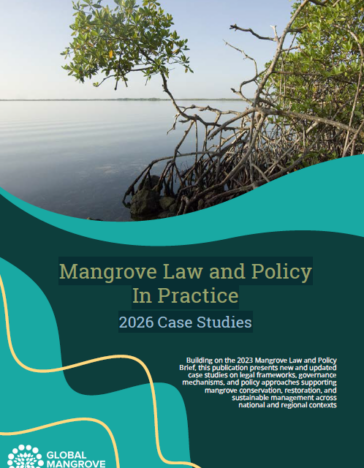

Mangrove Law and Policy In Practice – 2026 Case Studies
-
Coastal resilience
-
Coastal wetland conservation
-
Coasts & Deltas
A new publication by the Global Mangrove Alliance that showcases how countries are translating global commitments into tangible policy action for mangrove conservation, restoration and sustainable management.
The publication builds on the 2023 Mangrove Law and Policy Brief, and brings together 16 national and regional case studies that highlight emerging legal frameworks, governance approaches and policy innovations from around the world. It also shows how governments, researchers, civil society organisations and coastal communities are working together to strengthen the legal and institutional foundations needed to protect one of the world’s most valuable coastal ecosystems.
Why this publication matters
With countries updating their Nationally Determined Contributions (NDCs), revising National Biodiversity Strategies and Action Plans (NBSAPs), and preparing for major international milestones including UNCBD COP17 and UNFCCC COP31, attention is shifting from setting ambitious targets to delivering meaningful action on the ground. As countries work towards delivering their commitments, these case studies provide practical examples that policymakers, practitioners and partners can adapt to their own national contexts.
Together, they demonstrate that successful mangrove conservation depends not only on strong ecological science, but also on effective governance, inclusive decision-making, sustainable finance and long-term political commitment.
Across every case study, several common themes emerge:
• Strong policies rely on collaboration across sectors and institutions.
• Science and monitoring are essential for informed decision-making.
• Community rights, local knowledge and equitable governance are central to long-term success.
• Stable legal frameworks are critical to ensure conservation efforts continue beyond political and funding cycles.
Exploring mangrove policy in practice
The publication is organised around five key policy themes that reflect the diverse ways countries are strengthening mangrove governance.
It explores restoration protocols and showcases best practice mangrove restoration approaches from Indonesia, Mexico, Ecuador and Kenya that emphasise natural regeneration, science-based monitoring and landscape-scale planning.
The publication also highlights how countries are strengthening national climate commitments, with case studies from Cambodia, Costa Rica, Panama, Honduras, Jamaica and Belize demonstrating how mangroves are being integrated into Nationally Determined Contributions (NDCs) and supported through community land tenure and climate policy.
A third section examines finance, incentives and blue carbon, presenting emerging approaches in Asia to mobilising investment through blue carbon initiatives and innovative financing mechanisms that support both conservation and community benefits.
A case from Colombia in Chapter 4 illustrates how the country is embedding mangrove conservation into long-term biodiversity planning, while the final section explores how mangroves in the Bahamas, Brazil and Indonesia are being integrated into broader planning and governance frameworks, including coastal management, spatial planning and disaster risk reduction.
Wetlands International’s contribution
This publication reflects the collaborative work of the Global Mangrove Alliance Policy Working Group and its network of practitioners, researchers and policy experts. Wetlands International is one of the partners of this working group and has contributed with two case studies:
- Integrating Nature and Policy: The Ecological Mangrove Restoration Approach to Sustainable Mangrove Rehabilitation in Indonesia – Wetlands International Indonesia (page 8-10)
- Enabling National Best Practices in Mangrove Restoration in Kenya – Wetlands International Eastern Africa (page 17-19)