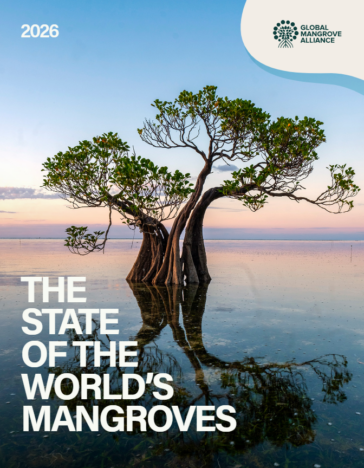

State of the World’s Mangroves
Mangroves are a fundamental resource for climate resilience, biodiversity and livelihoods. The 15 million hectares of mangroves across the globe offer communities essential services, income and protection. Coastal wetlands reduce impacts of flooding for almost half a million people and avoid some $2 billion in damages every year. They are also among the world’s most productive ecosystems. They are fish nurseries, carbon sinks and critical sea defenses.
After many decades of losing mangroves, the tide has turned and the total extent of mangrove ecosystems around the world is increasing.
The State of the World’s Mangroves 2026 paints a powerful picture of hope and collaboration. Grounded in the latest science from leading experts, this comprehensive report shows how mangrove cover is no longer in retreat and is actually increasing in many areas. This is a reason to be hopeful, but it does not mean the work is over.
Collaboration in Action

With over 190 government, community, practitioner and scientific contributors from 30 countries, the report spotlights partnership as a catalyst for change. Coordinated conservation efforts, like that of the Global Mangrove Alliance (GMA), are critical for reducing mangrove loss and degradation while increasing restoration. This 100+ member organization, led by The Nature Conservancy, Conservation International, IUCN, Wetlands International and WWF, illustrates the power of global partnerships that prioritize best practices to help existing mangroves flourish.
The 17 National Chapters of the GMA are leading exemplars of collaboration—bringing together government, NGO and regional groups who exchange knowledge across regions and sectors. These partners actively listen to one another, share insights and greatly influence the future of mangrove forests and of the lives that depend on them.
Mapping Mangroves
Mapping underpins so much of our knowledge about mangroves. Not only where they are being lost, or expanding, but where they are providing benefits, protecting people, storing carbon and supporting fishers. This year, Global Mangrove Watch v4.1, the world’s leading mangrove mapping and monitoring platform, and newly published research in Science Magazine have shown how we have reached a dramatic turning point for mangrove forests. With mangroves mapped back from 1985 to 2025, the new maps highlight the gradual slowing of losses over the last 40 years, and, about ten years ago, a reversal towards net gains.
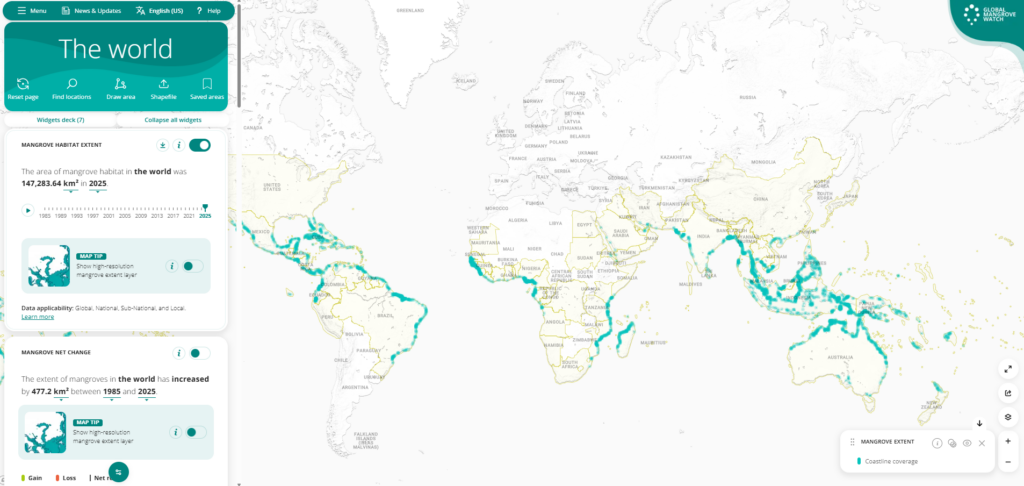
Gains are good news, but they don’t directly make up for the vast losses of old forests over the course of the last century or so. Around 65% of mangrove gains are actually found in areas where mangroves have not grown before, and in many cases, they are thriving on new sediment that was deposited in coastal waters as a result of deforestation and erosion far inland. And we cannot let the new forest gains hide the continued losses of older mangroves. The new forests will need decades before their benefits outweigh the significant losses felt from the continued degradation of old growth forests, from carbon storage and biodiversity habitat to flood protection.
Where losses continue it is important to understand the causes. Sometimes the impact is clearly attributable and there are stories and images throughout the report: direct clearance and conversion to urban areas in Guinea and India, Bahrain and Bali, aquaculture and illegal cutting in Senegal, ill-planned mining cutting off mangroves from the ocean in Mozambique; oil pollution in Nigeria. Other threats are more insidious, and harder to apportion, sea level rise rarely threatens mangroves as a single cause, but is very likely linked to losses when other factors, such as subsidence and hydrological disturbances upstream are also at play.
2030 and Beyond
At the halfway point to the Global Mangrove Alliance 2030 Goals, the report revisits the progress towards halting loss, doubling protection and restoring half and explores what these goals will achieve regionally.
To be effective, community partnerships are critical. The State of the World’s Mangroves 2026 delves into these partnerships through regional case studies of community led restoration efforts in Ghana, Brazil, Mexico, Qatar, Tanzania and the Philippines.
- Halting loss has always focused on direct, human-induced loss. It is different from halting “net loss”. This nuance is important given the newly reported gains. We still must halt any losses of original mangrove cover—newly established mangroves cannot be seen as replacements.
- Doubling protection, requires deeper consideration. The sharpened goal calls for doubling where appropriate, but adds a minimum target of 30% protection, and a challenge to reach 90% protection where current protection is already above 45%. Attention is also drawn to other forms of protection, noting that in many countries, regulations at the national level often offer at least partial protection to all mangroves.
- Restoring half of recently lost mangroves remains a clear target, although tracking progress is likely to remain a considerable challenge. Restoration takes time. Quick-fix mass plantings are rarely the solution. The report highlights restoration stories from around the world, from Brazil to Indonesia, Qatar to Tanzania.
The State of the World’s Mangrove 2026 unpacks the current state of global mangrove coverage. It shares stories of the progress communities are driving across the globe, but also the global science around and how increased degradation impacts a healthy future for nature and people. If we protect, better manage and restore mangrove ecosystems, we will tap into immediate and cost-effective solutions to combat the climate crisis, while addressing human livelihoods and biodiversity loss.