World Waking up to Wetlands: CBD COP17 focuses far more on inland waters
With the Armenian Presidency routinely highlighting Lake Sevan, joining the Freshwater Challenge and launching a flagship initiative on Mountains and Freshwater Ecosystems, there was a definite freshwater flavour to CBD COP17 in Yerevan.
Ahead of COP17, the Global Report on Progress towards the Kunming-Montreal Global Biodiversity Framework (KMGBF) highlighted that, despite an unprecedented increase in the incorporation of wetlands into national biodiversity plans, ambition and action for freshwater, coastal and marine ecosystems were lagging behind. So did the last two weeks in Yerevan help accelerate action? Here are some initial thoughts from the venue in Yerevan:
- Inland Waters: No longer on the outside looking in
On a very long final Friday night plenary session, which ran well into Saturday morning, one of the biggest cheers followed the adoption of the Global Review, which sets the direction for accelerated action and ambition, including on inland waters, whilst addressing the underlying drivers of ecosystem loss, and transforming economic and financial sectors and systems with negative impacts on nature.
“From featuring in almost every statement in the Leaders’ Summit to a constant flow of inland waters in the negotiations, new initiatives, side events and corridor conversations, there has been a much greater focus on the freshwater ecosystems that connect our communities and cities, and land to sea,” added Lee.
- Ka-POW! Action plan for inland waters to be updated for 1st time since 2010
COP17 was packed with tricky issues, which required a variety of Contact Groups, Friends of the Chair and Presidency interventions to chisel out a consensus agreement. One of these was definitely the issue of which Programmes of Work should be updated before the next COP in 2028. Fortunately, after intense negotiations, Parties agreed to update the Inland Waters Biodiversity Programme of Work – one of Wetlands International’s strategic priorities in Yerevan.
“The inland waters action plan was last reviewed in 2010 – half a decade before the Paris Climate Agreement was adopted – so this update is long overdue. Over the past 16 years a lot has changed, with growing recognition of wetlands as super solutions for climate mitigation and adaptation, fundamental components of the global water cycle, and critical natural infrastructure that underpins water and food security, wellbeing, peace and economic prosperity,” added MacKenzie.
“An updated Programme of Work can help translate this into accelerated wetland positive action and investments – with huge benefits for people, nature and climate. Wetlands International looks forward to supporting the new Programme of Work.”
- Restoration gaining ground…but freshwater lags far, far behind
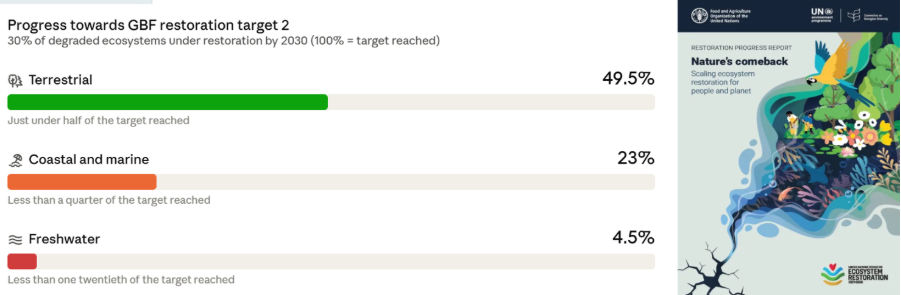
UNEP released its landmark Restoration Progress Report: Nature’s Comeback on October 29. It found that 252 million hectares in 149 countries – or an “area of land and sea the size of Kazakhstan” – is now under restoration. But while terrestrial restoration is ‘on track’ to meet the 30% goal under KMGBF Restoration Target 2, coastal and marine ecosystems are definitely ‘off track’ at just 23% of the way to the target. And then there is freshwater.
Restoring healthy wetlands is central to tackling the greatest challenges of our era: enhancing water and food security, reducing disaster risk from droughts and floods, reversing nature loss, mitigating and adapting to climate change, and driving sustainable development.
“Countries, companies, conservationists, cash-machines (aka investors) and communities must commit themselves to accelerate freshwater restoration. The alternative is a world with less safe water, food, peace, security, prosperity, resilience, hope, and, of course, species. And more extreme floods, droughts, wildfires, insecurity, and, of course, extinctions,” added Lee.
- Rising to the Freshwater Challenge…as Armenia becomes 55th member
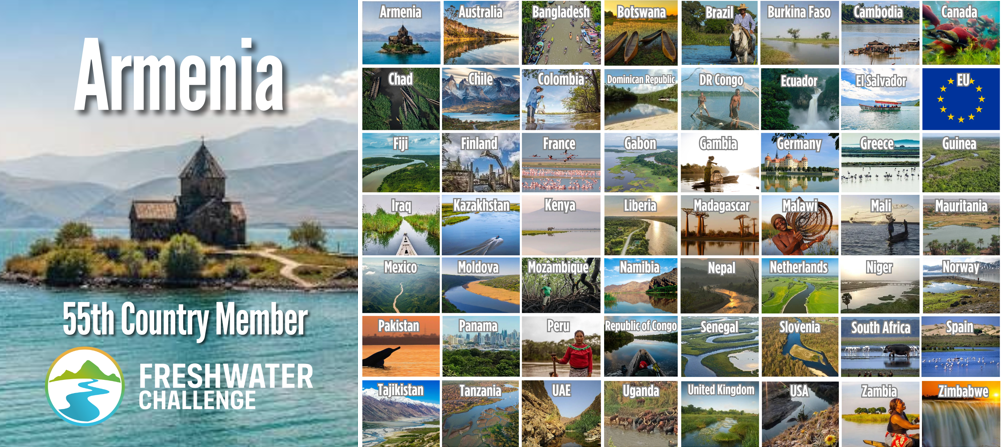
In a boost to global efforts to reverse the loss of freshwater biodiversity, the COP17 Presidency joined the Freshwater Challenge – increasing membership of the world’s largest freshwater restoration and protection initiative to 55 countries and the EU. The country-led Freshwater Challenge aims to ensure that 300,000km of degraded rivers and 350 million hectares of degraded wetlands are under restoration by 2030 (GBF Target 2), while protecting intact freshwater ecosystems (GBF Target 3).
“Momentum is building behind the Freshwater Challenge, with Armenia joining at COP17 and a number of other countries queueing up behind them. The challenge now is to turn members’ ambitious targets for river and wetland restoration into action. And the key to that: it’s the ‘F’ word – Finance. The world needs to rapidly funnel much more Finance into freshwater action.”
- Mangrove moments
Coastal wetlands were certainly not neglected, with the Leaders’ Summit hearing from several countries on increased areas of mangroves under effective protection and conservation measures. Side event speakers outlined how mangroves are seen as natural infrastructure for nature and people in Benin, and how the Global Mangrove Alliance chapters are succeeding in bringing diverse actors together and shifting practice away from planting and towards ecological regeneration.
- Rising tide of interest in the Rights of Nature
This concept build on Panama’s Law 287, which recognises Nature as a subject of rights, including the right to exist and the right to regeneration; and Law 371, which protects sea turtles and their habitats – such as mangroves essential for nurseries, food and shelter – connects marine biodiversity to the Rights of Nature framework, and incorporates prior consultation with Indigenous Peoples.
The Rights of Wetlands initiative was also showcased in a side event, illustrating the potential for ecocentric approaches across multiple MEAs, and the practical application of rights of wetlands to community-led restoration and conservation.
As a final boost to Rights of Nature – bot of the two countries running for the Presidency of COP18 in 2028 are fully behind the concept: Ecuador and Panama. In the end, Ecuador pipped Panama by 55 votes to 53.
“Rest assured, Rights of Nature will feature even more prominently in Quito in 2028,” said MacKenzie