
Kenya Launches Landmark Blue Carbon Ecosystems Plan at Our Oceans Conference
-
Climate mitigation and adaptation
-
Coastal resilience
-
Coastal wetland conservation
-
Community resilience
-
Mangrove Breakthrough
-
Biodiversity
-
Climate change
-
Coasts & Deltas

The Launch
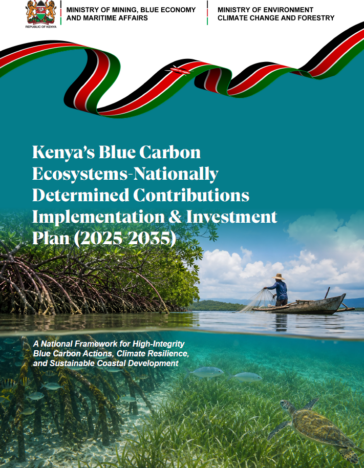
The Government of Kenya officially launched the Blue Carbon Ecosystems NDC Implementation and Investment Plan 2025–2035 at the 11th Our Ocean Conference (OOC11), marking a milestone in the country’s commitment to climate action and blue economy development.
Developed through a multi-agency Technical Working Group led by the Ministry of Environment, Climate Change and Forestry, and the Ministry of Mining, Blue Economy and Maritime Affairs, the plan provides an actionable, investable framework for deploying mangroves, seagrasses, and coastal wetlands to deliver Kenya’s climate commitments through 2035. It consolidates NDC obligations across two cycles (2020–2030 and 2031–2035) into a single national strategy.
Key targets include: restoring at least 75% of degraded mangroves, creating up to 70,000 jobs, and mobilizing USD 620 million in investment by 2035.
Why it matters
We envision a climate-resilient coastal Kenya where blue carbon ecosystems thrive, supporting the well-being of people, nature, and the economy.
“This initiative reaffirms Kenya’s commitment to the Paris Agreement’s transparency framework and strengthens our position as a regional leader in ocean-climate resilience and sustainable development,” said Dr. Deborah Barasa the Cabinet Secretary in charge of the Ministry of Environment, Climate Change and Forestry.
Kenya’s 61,000 ha of mangroves and 39,000 ha of seagrass beds store over 75 million tCO₂e — sequestering 5–10 times more carbon per hectare than terrestrial forests — while supporting 80% of coastal fisheries and more than 800,000 artisanal fishers.
Yet, mangrove cover has declined by 40%, with ongoing losses of 0.57% per year — equivalent to thousands of hectares lost annually. Seagrass beds are shrinking at 0.26% per year. Together, degradation costs the economy an estimated KES 6 billion annually through erosion, biodiversity loss, and coastal instability.
“This plan is critical for mobilizing the science, partnerships and financial resources required to protect and restore BCEs, ensuring they align seamlessly with Kenya’s climate and development goals. By advancing BCEs investments, Kenya can drive meaningful climate action and promote sustainable development,” said Dr. James Kairo, Chief Scientist at the Kenya Marine and Fisheries Research Institute and a Member of the International Blue Carbon Scientific Working Group.

5 Key result areas
The Blue Carbon Ecosystems plan is structured around five Key Result Areas that aim to:
- Conserve and restore all intact mangroves, restore at least 30% of degraded BCE areas, and protect 20,000+ ha of seagrass — reducing emissions by ~0.5 million tCO₂e by 2030 and generating tradable blue carbon credits at USD 30–50/tonne.
- Create 15,000–30,000 jobs by 2030 and 40,000–70,000 by 2035 through seaweed farming, mariculture, ecotourism, and other ventures, raising household incomes by 15–30% and generating USD 30–100 million in community revenues.
- Establish rigorous MRV systems integrating digital platforms, indigenous knowledge, and high-integrity carbon accounting aligned with Paris Agreement Article 6.
- Strengthen governance by clarifying mandates across national and county institutions, harmonizing benefit-sharing, and developing a national seagrass restoration framework.
- Mobilize USD 620 million (KES 80.1 billion) over 10 years through a four-tiered financing architecture spanning public grants, results-based finance, carbon, and biodiversity markets, green bonds, GCF, GEF, and bilateral donors — with commercial returns of 8–25% IRR.
Development partners
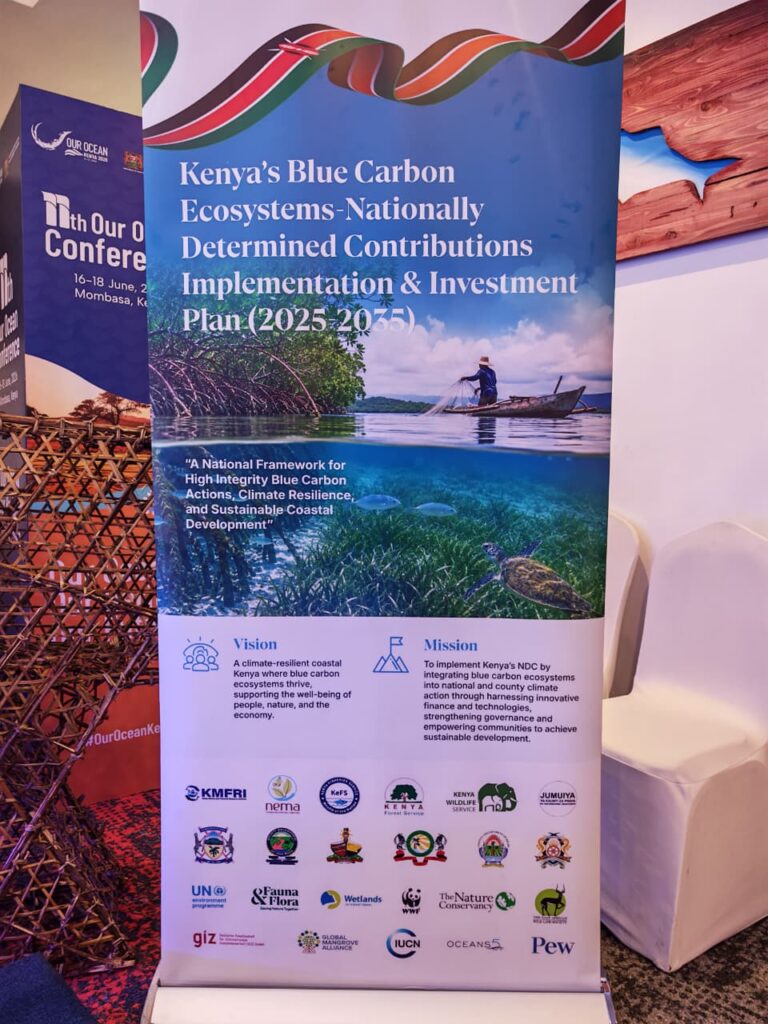
The Kenya Blue Carbon Ecosystems Plan was developed with the support from various development partners and regional organizations, including Fauna & Flora, The Pew Charitable Trusts, The International Union for Conservation of Nature (IUCN), Wetlands International Eastern Africa, World Wide Fund (WWF) Kenya, The Nature Conservancy, Global Mangrove Alliance, The East African Wildlife Society, GIZ, United Nations Environment Programme (UNEP), and the Government of Canada, among others, for their technical expertise and financial support throughout the formulation process.
“This Plan is an important step because it brings together what Kenya has been building over the years: science, policy, community knowledge, and partnerships into one clear roadmap for action. We know that protecting mangroves and seagrass is not only about conserving nature. It is about supporting fisheries, strengthening livelihoods, building resilience to climate change and creating opportunities for coastal communities. The real work now is implementing the Plan in partnership with the people who are already stewarding these ecosystems every day,” said Dr. Julie Mulonga, Regional Director, Wetlands International Eastern Africa.
“We are excited to be part of this process, ensuring we continue to catalyze the adoption of blue carbon ecosystems and ocean actions into NDCs. To achieve lasting and enduring impact, community-led solutions, sustainable finance, and enabling conditions are needed to drive action. This plan will help bridge the existing gap between climate ambitions and action,” said George Maina, Africa Fisheries Strategy Manager at TNC.
2035 Outcomes
By 2035, the plan aims to reduce 0.68–0.69 million tCO₂e in emissions, avert USD 200–500 million in coastal damages, increase fisheries productivity by 25% for 300,000–600,000 households, and position Kenya as a regional and global leader in ocean-based climate action.
We commend the collaboration between government, research institutions, partners, civil society, and coastal communities in developing this plan. We urge all stakeholders to continue supporting its implementation to protect and sustainably manage Kenya’s Blue Carbon Ecosystems,” said Hon. Hassan Ali Joho, Cabinet Secretary for Mining, Blue Economy & Maritime Affairs.