

Behind every successful wetlands COP lies a series of Standing Committees
Read the full story below, after a few key updates from Standing Committee 67 in Switzerland:
Thursday 7th: Big Win for Wetlands! The SC adopted the Indicator framework for the 5th Strategic Plan 2025-2034. Critically important follow up to COP15 in Zimbabwe and a real success to get this developed by STRP and adopted swiftly at SC67.
Wetlands International intervened during discussions on GeoWetlands:
Wetlands International regards the Geowetlands work as one of the very many incredibly valuable initiatives of the Convention, tailored to the needs of Parties, and we are honoured to continue to contribute including by coordinating the Geowetlands partnership as we have been doing for recent months, in addition to our national offices working directly with many Parties at national level. We consider it very positive that the 2026-2028 workplan and partnership agreement have been finalised, giving us a framework in which we can collaborate, to progress remote sensing of wetlands in a coordinated way in this triennium, as well as moving forwards on National Wetland Inventories.
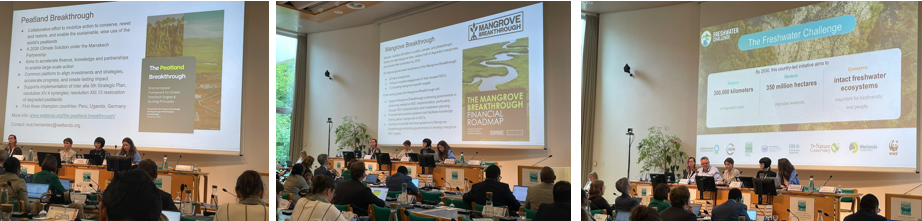
Wednesday 6th: The IOPs (Birdlife International, IMWI, IUCN, Wetlands International, WWF & WWT) provided an update at the SC on how they are providing support to deliver on the 5th Strategic Plan approved at COP15 in Zimbabwe. The IOPs highlighted their work with three voluntary, global initiatives on wetlands – the Freshwater Challenge, Mangrove Breakthrough and Peatland Breakthrough.
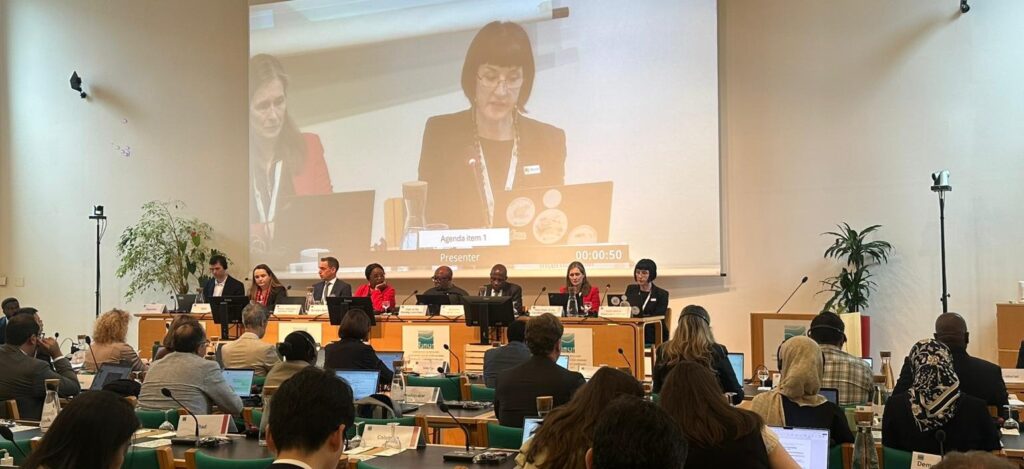
Tuesday 5th: Laura MacKenzie, Senior Advocacy Officer, Wetlands International delivered a statement during the Opening Plenary on behalf of all six International Organisation Partners (Birdlife International, IMWI, IUCN, Wetlands International, WWF & WWT).
The statement highlighted three key priorities for action – addressing the root causes of wetland loss and degradation, especially in finance and economic decision-making; reconfiguring human-wetland relationships including Rights of Wetlands; and establishing wetlands as vital to the delivery of other MEAs, and prioritising them as the critical watery connectors flowing through all three Rio COPs, and the UN Water Conference.
Wetlands International also made an intervention on the Global Waterbirds Estimates Partnership (GWEP):
Wetlands International would like thank the secretariat, and the UK STRP representative, for the comprehensive update on progress with the Global Waterbirds Estimates Partnership.
As we work together to deliver 2027 Waterbird Population Estimates, we would like to reiterate how essential the contributions have been: from the governments of Australia, Switzerland and the United Kingdom, Birdlife International, Manomet, and Wetlands International – notwithstanding the urgent need to fill the funding gaps.
It’s been a pleasure to work constructively and intensively with contracting parties, the STRP, and many other critical partners and collaborators since the adoption of the resolution last July at COP15, including as part of the interim coordination committee and as G-WEP secretariat, and we look forward to building on that over the coming critical months as this vital work takes flight.
———————————————————————————
In July last year, the irreplaceable value of wetland ecosystems for people, nature, and climate hit the global headlines, when Zimbabwe hosted the successful 15th Conference of Parties (COP15) of the Ramsar Convention on Wetlands. This took place beside the magnificent Victoria Falls: one of the world’s most famous Wetlands of International Importance, otherwise known as Ramsar sites – the jewels in the crown of the world’s wetlands, covering mangroves and mudflats, river and lake systems, and peatlands.
As with other global environmental agreements, COPs get almost all of the media and public attention, and rightly so. They feature critical political commitments from heads of state and ministers – in the case of COP15, the Victoria Falls Declaration – and they involve final, sometimes fraught, negotiations and the adoption of resolutions that set priorities for action over the coming years.
But countries also get together between COPs for important discussions. This week sees the first such intersessional meeting on wetlands since COP15: Standing Committee 67 (SC67), held in Switzerland, on the shores of Lake Geneva, another Wetland of International Importance.
Unlike the higher-profile climate COPs that take place every year, the next wetlands COP won’t be until June 2028. This makes these in-between meetings especially important for maintaining momentum, reviewing progress, strengthening accountability, sharing knowledge and tools, and deepening partnerships for delivery.
Wetlands International is participating, in close collaboration with the five other International Organisation Partners of the Convention on Wetlands: Birdlife International, IUCN, the International Water Management Institute, WWF, and the Wildfowl and Wetlands Trust.
This week’s Ramsar Standing Committee meeting is focussed on implementation of the new goals and targets adopted at COP15, which will drive wetland protection, restoration and wise use at national, regional and global level through to 2035. These will prioritize transformative change in wetlands, wetland-dependent communities, and the urgent need to accelerate efforts to tackle the main direct drivers of wetlands loss: climate change, unsustainable agriculture, poorly planned infrastructure, urbanisation, pollution and invasive non-native species.
This is also a critical meeting for Wetlands International and we will be focussing on five strategic priorities:
Demonstrating how our work supports delivery of COP15 resolutions:
As well as showcasing the extraordinary alignment of Wetlands International’s new strategy with the Convention on Wetlands 5th Strategic plan, we’ll have an opportunity to detail how our work in wetland landscapes all across the world supports the implementation of key resolutions adopted in Victoria Falls. These include the conservation and restoration of waterbird flyways and critical sites; restoration of degraded freshwater ecosystems and the contribution of the Freshwater Challenge; and the designation and management of wetlands as protected areas or OECMs (other effective area-based conservation measures) as part of their vital contribution to 30×30 target of the Global Biodiversity Framework.
Contributing to Ramsar’s vital technical and scientific work
We’ll update Contracting Parties on our contributions to some of the essential technical and scientific work that underpins wetland action, including site designation and management, such as the Geowetlands earth observation initiative, and the Global Waterbirds Estimates Partnership.
Highlighting need to factor values of wetlands into finance and economic policy
In light of the new IPBES business and biodiversity assessment, and UNEP’s State of Nature Finance report, which found that for every dollar invested in protecting nature, thirty dollars are spent destroying it, we’ll spotlight the urgent need for greater progress on incorporating the value of wetlands into finance and economic policy, as well as sharing examples of practical examples of progress. Too often, we still see wetland safeguards undermined rather than strengthened in the name of development: such as the recent weakening of laws protecting glacier areas in the High Andes, which will exacerbate threats posed by lithium mining to wetlands and water security across the region, as well as the proposed dilution of the EU Water Framework Directive. Both of these are serious causes for concern.
Building momentum behind some big ideas
As part of our drive for transformative solutions, we’ll explore support for a potential new draft resolution on the rights of wetlands, building on an IUCN resolution adopted in November on the rights of rivers. We’ll also share success stories of how the Freshwater Challenge, Mangrove Breakthrough and Peatland Breakthrough bring together governments, NGOs, private sector and finance to accelerate wetland conservation and restoration. We’ll encourage even more governments to join these voluntary global initiatives, highlighting how they help enhance the mainstreaming of wetland action into countries’ targets and plans to boost efforts to meet climate, biodiversity, water security and sustainable development goals.
Supporting multilateralism as central to delivering water and wetland action
2026 started on a high note for wetlands and for multilateralism with the Convention on Migratory Species COP15, hosted by Brazil, adopting decisions on flyways, connectivity and migratory wetland species; and the Pantanal Declaration championing the central role of wetlands - not just in biodiversity conservation, but in climate regulation, water security, and community livelihoods. This week will give us a valuable opportunity to set out how that can continue: by ensuring wetlands are prioritised as critical watery interconnectors at all of the three upcoming Rio Convention COPs and the UN Water Conference.
Finally, we will be looking forward to one of the most inspirational agenda items – the update from Panama on their plans for hosting the Convention on Wetlands COP16 in Panama City in June 2028. Following Zimbabwe’s successful COP and its championing of wetlands as President, Panama will have a hard act to follow. But it’s global leadership on nature, and wetlands in particular, bodes well. With an office in the country, Wetlands International is committed to supporting Panama to build on the current momentum around wetlands and ensure that the next COP further accelerates wetland action worldwide.